0
0

KARACHI, June 20: Sindh Finance Minister Abdul Hafeez Sheikh presented on Thursday the first-ever revenue surplus budget of the province for the fiscal year 2002-03, estimating a revenue income of Rs84.901 billion and current expenditure of Rs 84.807 billion, showing Rs94 million surplus.
Keeping up with the traditions of the last two budgets, the minister declared that the next budget, too, was tax free and that no increase had been proposed in the rate of any provincial tax.
He said the current fiscal 2001-02 was ending in Sindh with a revenue deficit of Rs5.96 billion. The revenue expenditure swelled to Rs77.66 billion against the originally anticipated Rs71.70 billion because of the increase in the salary of the government employees announced in December. Total revenue receipts in the outgoing fiscal year were estimated at Rs72.21 billion while the size of the ADP was Rs4.50 billion.
The minister did not offer any explanation how this revenue deficit was being plugged and from what sources the total ADP of Rs4.5 billion was financed. He claimed having relieved the province of the State Bank’s overdraft which was Rs2.9 billion at the beginning of the current fiscal.
“Your province has now a positive cash flow after more than a decade of overdrafts with the State Bank,” the minister declared in his budget speech broadcast on television and radio.
He announced a Rs14.48 billion development outlay for the next fiscal and added that it represented the “largest allocation for development in the history of Sindh”.
The development outlay includes a Rs7 billion ADP to be funded entirely by the province, except a meagre Japanese grant of Rs22 million. There are foreign-aided projects with an outlay of Rs2.88 billion, a Rs2.80 billion Khushal-i-Pakistan programme, and Rs1.80 billion planned to be spent as Drought Emergency Relief Assistance.
The first volume of the budget documents offers an interesting note at the bottom of the development outlay. It says: “Provincial contribution (Rs4.52 billion) and funding of oversized ADP will be subject to availability of resources”.
A noteworthy feature of the budget is that 40 per cent of the current revenue expenditure has been split into 60pc for the provincial administration and the remaining 40pc being shared by the 16 districts. Thus, there are 16 budget documents giving details of department-wise salary and non-salary component allocation for each of the 16 districts in the province.
The development programme as determined by the Provincial Finance Commission (PFC) would be divided with the ratio of 70pc for the districts and 30pc for the provincial administration, he said.
The minister said the PFC had come out with an interim award which was formula based and would be reviewed again in September or October. All the divisible taxes, including the provincial tax revenue, would be distributed at the ratio of 60:40 between the provincial and the district governments whereas the development budget would be shared at the ratio of 70:30.
He gave details of the revenue receipts amounting to Rs84.901 billion, including Rs37.06 billion to come as federal transfers from the divisible pool of taxes, Rs18.85 billion straight transfers on account of oil and gas surcharges and excise, Rs10 billion federal grants as 2.5pc share in the GST, Rs6 billion IDA credit and provincial revenue generation of Rs13 billion.
Besides, the 2002-03 budget shows total capital receipts of Rs2.26 billion and capital expenditure of Rs3.93 billion.
The minister announced that the government had decided, in principle, to abolish the Motor Vehicle Tax “to reduce hassle of the citizens and plug avoidable leakage of revenue”. The MVT would be replaced by a ‘revenue neutral road user charge’ once the federal government gave its approval, he added.
After the completion of the review currently under way, the minister said, the professional tax and revenue collection of the land and agriculture tax would be simplified and other stamp duties would be abolished.
Mr Hafeez announced an allocation of Rs1.2 billion for the setting up of a Pension Fund with a view to ensuring that pensions were secure and readily available to retiring employees.
The minister expressed the determination to continue with what he called a pro-education policy of the government. He announced that the non-salary expenditure of the primary education was being increased by 50pc in the next fiscal after a 100pc increase made in the current fiscal. He said the government would provide free books for all the children in the government primary schools. Every girl student would be paid Rs100 monthly after she got through the primary stage and entered the middle grade.
A Rs1 billion Endowment Fund is being set up to provide scholarship to students who would get admissions to top universities of the country on merit but would not afford to pay. The minister said that an independent board was being set up to ensure proper utilization of this facility. The first instalment of Rs200 million had already been allocated in the budget, he added.
In the health sector, the budgetary allocation is being increased by 31pc for medicines and equipment.
He announced recruitments to be made on merit, including 2,200 police constables, 1,500 ASIs, and 700 vaccinators. More than 3,000 teachers have already been hired.
Mr Hafeez said the outgoing year had been full of challenges “for our country and for the province”. He mentioned the Sept 11 event and the subsequent conflict in the region which had adversely affected the national economy. Sindh obviously could not remain immune from the fallout, he said. Adding to the woes was the unprecedented shortage of water.
During this year, he said, the local government system had been launched. “This devolution has far-reaching consequences on how the government will function, how political authority will be balanced, how services will be delivered and how financial services will be divided and utilized,” he said.
In the face of these internal changes and external shocks, the minister said, the provincial government had stayed with the course of the broad economic reforms agenda it had set for itself.
Outlining the objectives of this agenda, he said it would restore financial discipline, reduce debt burden, cut down, rationalize and simplify taxes, deregulate the economy and increase private sector’s participation, enhance and improve the development programme, focus on delivery of service in education and health sectors, and reorient relationship with international financial institutions.
He said the federal government was assisting in the development of Sindh in addition to the ambitious programme being under taken by the provincial government. He said a road development programme costing Rs14 billion was being launched with the help of the Asian Development Bank to build over 1,500km of roads in the province.
OTHER KEY AREAS:
•Establishment of an IT university in Karachi.
•Establishment of IT centres in Sindh.
•Supplement Wapda’s efforts by providing funds for rural electrification programme.
•Town planning and airstrip at Islamkot.
•Crash programme for training of nurses.
•Upgradation and strengthening of district hospitals.
•Equipment for Sindh Institute of Urology Transplantation.
•Improvement of Korangi-Hino Chowk, and Hino Chowrangi to Korangi Crossing, and
•Construction of a road network in Thar.
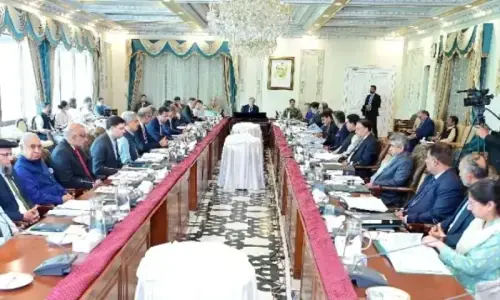
APPROVAL: Meanwhile, the cabinet met and approved the budget for the 2002-03.