



 0
0

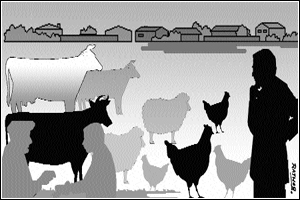 Despite commercialization, the role of livestock in the economy of Pakistan reflects traditional rural orientation. The primary purpose of livestock raising is to support the crop farming operations with income generation.
The close integration of livestock rearing with rural subsistence economy has taken place by the use of crop residuals for feed and fodder. However, in the wake of socio-economic development, this sector had to be geared up to increase its output, both for food — meat, eggs and milk —, and for industrial raw material — wool, hair, hides, skins, bones etc,.
The rearing of cattle, sheep, goats and poultry farming has assumed a status quite distinct from, and independent of crop farming.
In the beginning of the 21st century (2001-02), the livestock made up around 37.7 per cent of the agriculture and 9.3 per cent of the GDP on the basis of doubling its growth rate to 4.8 per cent. With strong growth in poultry products (white meat and eggs) all other components of livestock, both in terms of population and products, showed positive growth as is evident from the following figures.
As livestock is less vulnerable to adverse weather conditions, it creates an alternate source of income and is able to diversify farmers’ risk portfolio.
This sector has grown up by an average growth rate of 6.4 per cent during the past 10 years, clearly out-performing all other sub-sectors in agriculture.
Trend of livestock population: Unlike crop production, estimates are made annually on the basis of figures provided by the reporting agencies of the provinces.
However, the livestock wing of the ministry of food and agriculture estimates and issues annual figures as well as the data of various livestock products on the basis of sample surveys.
In order to conjecture scientifically what we shall have in the 21st century, both in live animals and their products, we have no ready-made formula to arrive at near-exact figures, except for making projections on average growth. Thus, if the projected estimates turn out close to the actual availabilities, we shall be facing a formidable stock of live animals and proportionally large output of their products. These in return will need matching arrangements for their optimal utilization.
Marketable surplus: The estimated animal population do not move in marketing channel for their economic utilization. It is estimated on the basis of some adhoc studies. Percentage wise livestock available for marketing are cattle 70 per cent, buffalo 80 per cent, sheep 40 per cent and goats 45 per cent.
Of these estimated percentages, the off-take of sheep and goats is pretty low. This proves unnecessary holding of their stocks on rangeland. It happens due to the lack of urge on the part of nomadic breeders to part with their surplus stock. As a matter of prestige, holding of a large number of livestock in rural areas works against the speedy disposal of surpluses. Other reasons for the state of affairs may be very few material needs in the life of nomadic breeders and the risk in carrying cash around, which is not involved, if credit is kept in the form of animals.
Consequently, a large number of unproductive and uneconomic animals are allowed to stay unnecessarily on the rangelands. This aggravates the problem of over-stocking resulting in feed shortage and unhealthy animals. There is an urgent need to bring improvement in the existing marketing mechanism to funnel off the problem of over stocking.
Livestock products and their utilization: The large number of products, both edible and usable as industrial raw material are obtained from different species of animals. The edible products include meat and milk supplementing the human diet with animal protein. Wool, hair, hides, skins, blood, bones and casings are comprised important industrial raw materials. These help feed different domestic industries leaving sizeable quantities for export.
The availability of various types of livestock products may be proportionally projected on the basis of their annual average for the last 10 years which comes to about 5 per cent. With the advent of 21st century, appreciable quantities of these products have started becoming available which are expected to rise considerably.
Therefore, some immediate steps may be taken to handle the formidable availabilities of both livestock and their products on modern lines.
Pakistan is likely to be endowed with far enormous availabilities, both of livestock animals and their products. To handle these viably and profitably for breeders, traders and consumers, foolproof arrangements shall have to be lined up by the public and the private sectors.
As for the importance and the significance of livestock sub-sector, it is a fairly large contributor to the agriculture sector. The country, in no circumstances, should be oblivious of this fact and should guide up its loins right now to be prepared for facing the situation of surpluses boldly. It is, therefore, suggested that the preparation of necessary planning in this regard be given due priority.
For this purpose a task force comprising experts may be constituted with modest terms of reference and timeframe for completing the job. Its cost may be met through the levy of cess on big breeders and traders, and partly through grants and donations by some expatriates on the lines of German foundation for development.
This foundation in the past, alongwith the FAO-financed a programme of development of rural markets in South Asia in the late seventies, wherein Pakistan, Bangladesh, Sri Lanka, India, Philippines and South Korea have participated.




























