0
0

 ISLAMABAD, June 12: Paying tribute to Ali Imam is not merely paying respects to an artist but, as Professor Khawja Masood rightly said, paying homage to “a many splendoured, genius”.
For the late artist who died in the early hours of May 23 this year was an artist, a teacher of art, a knower of art, a promoter-lover of art and artists in Pakistan — and in his early life — a trade unionist, all rolled into one.
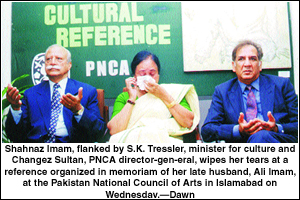
Glowing tributes were paid to the late artist at a cultural reference organized by the Pakistan National Council of the Arts in Islamabad on Wednesday evening.
Born in Narsingpur in Madhya Pradesh, the late Ali Imam went to the Nagpur School of Arts in the early forties of the century just gone by. He also studied at the famous J.J. School of Art in Bombay. He received his B.A, from the Punjab University and studied at the Gordon College in Pindi. He then went to St. Martin School of Art in London. He was also the Principal of the School of Art and Craft in Karachi and was the first artist in Pakistan who organized an Art Gallery where old and new artists were exhibited. Display of one’s paintings used to be a great hour for a budding painter, said some of the speakers at the reference.
Prof. Khwaja Masud, who had been his teacher, described how his distinguished student became his teacher in art. He also said that Ali Imam had organized the first May Day demonstration in Pindi and he also established the Democratic Students Federation (DSF) in Gordon College.
“You never say farewell to sunshine”, Khwaja Sahab mused as he finished his tribute to “a many splendoured genius”.
Culture Minister Col S.K. Tressler, who presided over the function, said that although he had not met the artist in his life, the tributes paid to Ali Imam showed that he was not merely an artist but a revolutionary and a genius in may directions.
The minister promised all help in publishing the great material on Pakistani art and artist that was collected by the late artist after painstaking effort.
He asked the Pakistan National Council of the Arts, of which he is the ex-officio chairman, to help in getting this material published.
The art-loving secretary of the Statistics Division, Abu Shamim Arif, spoke of his association with the artist and said that Ali Imam was like Jean Paul Sartre because, like him he did not believe that prizes can add to anybody’s excellence in his work. Sartre did not accept the Nobel Prize when it was offered to him.
Artist Mansur Rahi said, Ali Imam knew finer points of paintings and knew how to appreciate them.
Artist and architect Naeem Pasha said in his early days Ali Imam, visiting Faiz Sahab, had asked him about some concrete social ideals that the artist had, and also showed his paintings to the great poet. Faiz Sahab, he remembered, had remarked that he should go on working on paintings, the ideas will themselves materialize.
Raja Changez Sultan, the PNCA director-general, said that the Council had also held a dialogue with him on art in March in Islamabad and one in Lahore. He was also chairman of an exhibition going to be held in January and February next year by the Council. He assured Shahnaz Imam, the widow of the artist who was present there, to do all he can in publishing the material collected by his great husband.
Dr Arjumand Faisal, a medical doctor by profession but a helper of artists by “inclination” read out a poem in Urdu which said that he came to this world along with a rainbow.
Mussarrat Naheed Imam of the PNCA spoke of visionary, the teacher and the artist in Ali Imam. She said that Imam was labelled as a subversive political activist, Marxist, communist and a labour union leader in his youth. He lived his life never to comprise and surrender although he mellowed later on the advice of his near and dear ones. In his paintings, his selective subdued palette, subtle tones, sensitive and delicate rendering and strong perception is a unique blend of vigour and sensitivity.
Dr Alyia Imam, presenting her tributes in the traditional flowery Urdu spoke of him as Greek god who would share the wounds in the chest of all those who suffer.
Mr Jamal Shah, artist and actor, spoke of the brilliance of the artist, while Brig, Mohammad Ismail Siddiqi, his friend for 55 years spoke of bauhat agay gaye baqi jo hain tayyar baithe hain (many friends have gone, others are ready to go).
In sum, the very fact that so many artists and art lovers attended this homage to an artist and promoter of artists in this sweltering heat of Islamabad showed the influence he has left on his community.— Mufti Jamiluddin Ahmad