0
0

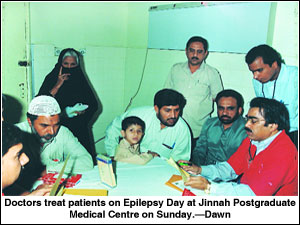 KARACHI, March 2: The National Epilepsy Centre was inaugurated at the Jinnah Postgraduate Medical Centre on Sunday morning.
The Epilepsy Association of Pakistan observed the Epilepsy Day at the neurology department of the Jinnah Postgraduate Medical Centre, in collaboration with the Pakistan chapter of the International League Against Epilepsy. The day was observed under the banner of “Global campaign against epilepsy”.
The president of the Epilepsy Association of Pakistan, Prof Emeritus Hasan Aziz, said 1.4 million people were afflicted with the disease in the country. He added the earlier the disease was diagnosed, the better it was.
He said: “Even in this cyber age, epilepsy has been unable to completely free from the associated myths, superstitions, misconceptions and stigmas. The quantum of the physical suffering of the afflicted is unnecessarily multiplied because of it.
“The knowledge about the treatability of this disorder and hence the treatment-seeking attitude of the afflicted is poor; more so in the developing world. Experts all over the world are striving hard to remove these wrong notions.”
As part of the Epilepsy Day, patients were provided free consultancy. They were urged to continue with their treatment irrespective of societal pressures. Epilepsy awareness workshops for teachers were also held because they are usually the first ones to learn about the disease in children. They could urge other class-fellows of a child suffering from epilepsy to treat him kindly.
Schoolchildren took part in a drawing contest which was titled “Healthy brain, successful life”. The drawings were judged by Shahid Sajjad and Mumtaz Mehar. A documentary movie, titled Tareeki say roshni ki janib, was also screened.
Rahila Tiwana, deputy speaker of the Sindh Assembly; Prof C.T. Tan, chairman, Commission for Asian and Oceanian Affairs, International League Against Epilepsy; and experts from other cities of the country were at the Epilepsy Day function. The philanthropist who donated the funds for the National Epilepsy Centre, Ahmed Tabba, was also there.
The experts said that epilepsy was a commonly prevalent treatable disorder. “In spite of advancements in the diagnosis and therapeutics of this more than a century-old disorder, it still remains in the shadows of various myths. To-date, epilepsy is associated with misconceptions like being possessed by a devil or an evil spirit, witchcraft, sorcery, madness and other problems.”
They said: “Epilepsy, the most common serious disorder of the central nervous system, affects at least 50 million people worldwide, 85 per cent of them living in developing countries.
It is estimated that up to 80 per cent of afflicted persons can lead normal lives with proper treatment. But, unfortunately, the problem is that more than 70 per cent of the affected or their families are unaware of it. Many organizations in our country, including the Epilepsy Association of Pakistan, are alive to the problem and are taking steps in the right direction for creating awareness about this disorder and for treatment of more and more people to help them lead normal lives.”