



 0
0

PARIS, Nov 11: Yasser Arafat, the guerilla icon-turned Nobel peace prize winner who ended up isolated and locked in renewed conflict with Israel, died on Thursday , his dream of a Palestinian state unfulfilled. He was 75.
The announcement of the death of the Palestinian president, who symbolized his people's decades-old struggle for an independent homeland, ended days of confusion over his fate as he lay comatose behind a shroud of secrecy in a Paris hospital.
French doctors at the Percy military hospital said Arafat had died at 0230 GMT but refused to give an exact cause of death, saying that information was for his family only.
In a sombre ceremony at a military airport outside Paris, Arafat's wife Suha wept as his coffin - draped in a Palestinian flag - was placed in an official French plane by an honour guard.
The jet took off at 1630 GMT for Cairo, where world leaders would gather to honour Arafat at an official funeral on Friday. Arafat's body would then be transported for burial to the West Bank city of Ramallah that has been his virtual prison for almost three years. A top Palestinian cleric told Reuters Arafat would be buried in a concrete coffin that could later be moved to Jerusalem.
Fears remained of a succession fight that could thrust the Palestinian territories into chaos and push the region into deeper crisis.
With Arafat having indicated no preferred successor, Palestinians quickly installed a collective leadership, handing top positions to moderates and hardliners alike in a bid to avoid a power vacuum. Former premier Mahmud Abbas was appointed chairman of the Palestine Liberation Organization and parliament Speaker Rawhi Fattuh was installed as the caretaker head of the Palestinian Authority for 60 days.
Prime Minister Ahmed Qorei, another leading moderate, was expected to remain in charge of the day-to-day governing. Farouk Kaddoumi, an exiled hardliner, was named to take over as head of Fatah, the dominant Palestinian faction
Palestinian officials declared40-day official mourning.
"The Palestinian leadership mourns with our people, with the Arab nation, with the whole of humanity, (the loss of) the tutor, the leader, the son of Palestine, its symbol, the builder of its modern nationalism and the hero of its battle for freedom and independence," said Tayeb Abdelrahim, the head of the Palestinian Authority leader's office.
Although Arafat will not be buried in Jerusalem as he had hoped, Palestinian officials said he would be buried on soil brought from the holy city, home to the Al Aqsa mosque compound.
At the battered Muqataa, Arafat's headquarters in Ramallah, burial preparations were under way, with the grind of trucks and heavy earth-moving equipment rumbling through the night.
Several hundred people were allowed inside Muqataa where a book of condolence had been opened.
"Where have you gone Abu Ammar (Arafat), why have you left us," wept 55-year-old Umm Ahmed as she sat inside the compound.
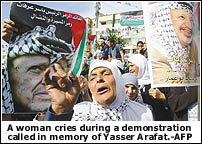
In towns and refugee camps across the occupied West Bank and Gaza Strip, tens of thousands of Palestinians poured into the streets with wails of grief and volleys of gunfire.
"Our father is dead," construction worker Fathi Abu Adnan said in Gaza City, where youths burned tyres, sending up plumes of black smoke as Quranic verses were recited on loudspeakers.
Some mourners bore portraits of Arafat, for decades one of the world's most recognizable leaders. Short and balding, his face framed by a chequered black-and-white headdress, Arafat had usually appeared in public in military fatigues and with a pistol strapped to his waist.
Arafat was probably the world's best known guerilla leader. His death came almost 30 years to the day after he stood before the UN General Assembly, saying he came with "an olive branch and a freedom fighter's gun," adding "do not let the olive branch fall from my hand."
Arafat won the Nobel peace prize 10 years ago after the Oslo accords. He returned from exile in 1994 after the interim peace deals. For those agreements, he shared the Nobel peace prize with Israel's Shimon Peres, then foreign minister, and then prime minister Yitzhak Rabin, later assassinated by a Jewish ultranationalist.
But the peace process collapsed four years ago with the launch of the Palestinian intifada against Israeli occupation. Fighting resumed and Israel reoccupied much of the West Bank amid a wave of suicide bombings by Palestinian freedom fighters.
With condolences for Arafat's death pouring in from across the globe, Palestinian officials urged Israel to revive stalled talks, and Israeli Prime Minister Ariel Sharon said it could be a 'turning point' for peace if Arafat's successors ended violence.
Hardliner group Hamas vowed to keep up attacks against the 'Zionist enemy'. Hamas leader Khaled Meshaal pointed the finger at Israel.
"I accuse Israel of having poisoned the blood of Abu Ammar," said Meshaal. "By killing Arafat today, Israel has killed the peace process."
Meanwhile, amid fears that Arafat's death could trigger an outbreak of violence, the Israeli army imposed a total security clampdown on the West Bank. Reinforcements were deployed around towns and Jewish settlements in the West Bank while extra police were stationed in east Jerusalem.
FUNERAL PREPARATIONS: Egypt, where Arafat began his political life and where biographers say he was born, prepared a funeral for the Palestinian president.
Arab and Muslim heads of state and government, as well as leaders and ministers from around the world, would take part in a military funeral procession expected to start at a mosque in Cairo, official sources said.
Funeral plans were still in flux, but officials said ceremonies were expected to begin at 11am (0900 GMT).
A spokesman for the Arab League, headquartered in Cairo, said plans to hold prayers in King Faisal mosque were changed because of security concerns.
Ceremonies would now be held at a mosque closer to the military airport and a military hospital where the coffin was expected to remain overnight, he said. The prayers would be followed by a military procession.
Egypt's official Middle East News Agency said traffic would be redirected and the public kept away. A public ceremony would be held in central Cairo's Al Azhar mosque.
The Arab League said it would open a book of condolences on Friday for Arab and foreign dignitaries to sign over the next three days. The organization would hold a special commemoration session on Saturday at noon.
Egypt has been a key mediator in the Palestinian-Israeli conflict after signing its own peace treaty with Israel in 1979, the first Arab state to do so. The treaty was condemned by many Palestinians and much of the Arab world at the time.
Biographies say Arafat was born in Cairo in 1929, although Arafat himself said he was born in Jerusalem.
He studied engineering at Cairo University, and began his political life there by taking over the Palestinian Students' League in 1952.
He was also a regular visitor to Egypt throughout much of his life as head of the PLO.-Agencies





























