0
0

ISLAMABAD, Oct 9: The unprecedented rise in international oil prices has started hitting budget, and the national exchequer lost Rs15 billion between May 1 and September 1, 2004.
Informed sources told Dawn here on Saturday that the government had not been charging the Petroleum Development Levy (PDL) since May 1, and is reluctant to offset the loss by imposing new levies for fear of criticism by the opposition parties.
The government has decided not to pass on the effects of the rising oil prices in the hope that the international price would come down to $40 a barrel. But instead the price has touched the record high of $53 a barrel due to various reasons including the threat by Nigerian rebels to blow up oil pipelines, tornado in Florida and the arrest of a Russian business oil tycoon.
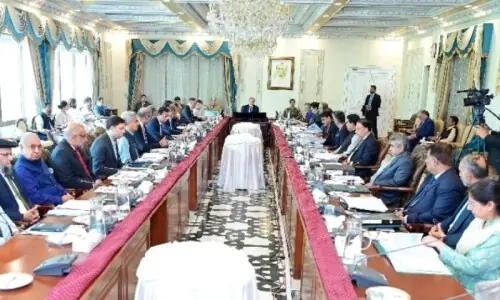
Sources said that Prime Minister Shaukat Aziz has asked the ministries of finance and petroleum to review the issue to save the national budget from a negative fallout.
At the same time, he said, problems of common man should be kept in view if the situation demanded an increase in the domestic oil prices some time after Eid.
The Economic Adviser to the Ministry of Finance Dr Ashfaque Hasan Khan, when approached, said that the situation was serious but not alarming as the government was monitoring it from the day the international oil prices started climbing up.
He said that the government was exploring new avenues to improve its resource mobilisation position so that the effects of the oil prices could be minimized to some extent. For example, Dr Khan pointed out that the Central Board of Revenue (CBR) collected Rs123.6 billion in August against the target of Rs112 billion. "There was a 31 per cent higher growth in revenues in August this year compared to corresponding period last year," he said hoping that the additional revenues would help the government to save the budget from unnecessary problems.
He said the government had done "a great favour" to the common man by not enhancing oil prices. "We have protected the common man from unnatural increase in international oil prices. This is the human face of Prime Minister Shaukat Aziz's government," he asserted.
If the government had allowed concurrent increase in domestic oil prices in May, the current 9.3 per cent rate of inflation would have jumped to 13.5 per cent by now, he said.
"Then the State Bank would have come under tremendous pressure to aggressively tighten its monetary policy," he said.
In case oil price was increased, interest rates would have gone up and the investment and growth projections would have faced negative effects, the economic advisor said. Likewise, the debt servicing would have increased and Pakistan would have had to borrow on higher interest rate. "Lending rates would have doubled in that case."
Asked whether the government has worked out any contingency plan or has taken additional measures to offset the impact of the increasing oil prices in the world, Dr. Khan said that the government was very much at it and that there was nothing much to be worried about.
"We have averted pressure on exchange rate by not increasing oil prices," he claimed adding that the government has calculated the "exact cost" of not increasing these prices.
"And in the process we have saved our people from multi dimensional effects by having unchanged oil prices since May this year," the economic adviser said.
Asked about the reasons of increasing oil prices in the international market, Dr. Khan said that oil traders were indulging in speculation in future oil prices in collaboration with Opec and non-Opec oil producing countries to keep these prices artificially high.
He regretted that the World Bank and the IMF did not take real notice of the unprecedented oil price increase in the international market. "Under these circumstances this is more disturbing to hear from these two donor agencies that despite oil price increases, generally there would be a 5 per cent GDP growth during 2004 in the world," the economic advisor said.