0
0

ISLAMABAD, June 12: Finance Minister Shaukat Aziz unfolded here Saturday a Public Sector Development Programme (PSDP) with a total outlay of Rs202 billion for the fiscal 2004-05, which is 31 per cent higher than the outgoing year.
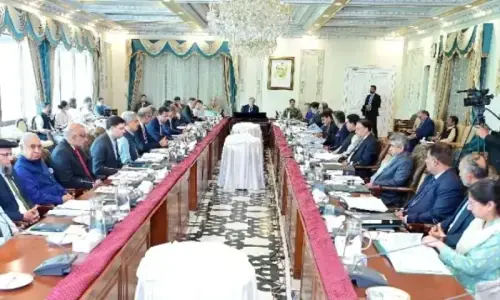
As approved by the National Economic Council (NEC) in its meeting held on June 1, the overall PSDP outlay is broken up into federal PSDP and provincial PSDP with allocations of Rs148 billion and Rs54 billion, respectively.
In terms of percentage, the federal programmes gets 73.27 per cent of the total PSDP funding.
Over 17.32 per cent of the overall PSDP outlay or Rs35 billion is accounted for by foreign aid component.
According to details of the federal PSDP provided in the document supplied as part of the budget kit, only about Rs19 billion (nearly 13 per cent) is to be spent on new schemes, while all the rest will be consumed in the implementation of ongoing schemes.
This component is diminished further if the schemes categorized as 'unapproved' are also taken into account.
Thus the real outlay for approved schemes included in the PSDP for the first time comes to Rs14.57 billion - 9.85 per cent of the total federal PSDP.
One is therefore left wondering as to how far this kind of funding would go towards realization of the "basic agenda of the present government" which purportedly envisaged reducing poverty, ensuring good governance, generating employment and raising the quality of social services.
Towards this end, it is stated, the programme aims at laying a firm basis for enhanced future growth through investments in infrastructure and human resources.
To avoid a thin distribution of the resources, and consequent time and cost overruns, the PSDP document further explains, priority in the allocation of resources has been given to those projects scheduled for early completion.
The programme caters to commitments for major projects such as the Chashma nuclear power plant, raising of Mangla Dam, lining of water courses, important communication projects, including the Gwadar Port and Gwadar area development.
The government would consider providing guarantees in appropriate cases for corporations such as Wapda and the NHA to arrange additional resources outside the budgeted programme in order to complete projects on schedule.
The document is, however, silent on the actual utilization of PSDP funds provided in 2002-03. The throwforward on development allocations has been provided only for individual ministries/divisions/programmes but not in the cumulative table which provides only comparative figures of allocations for the outgoing year and the next one.
The list includes a total of 1,275 schemes, both new and ongoing. The largest chunk - 337 schemes - belongs to the Higher Education Commission.
The distinction is also matched by the size of allocation - Rs9.1 billion - placing HEC on top among the social sector heads the allocation of which amounts to Rs31,283 million as against Rs22,813 million for 2002-04.
Curiously, labour, women development and population welfare stand out as heads for which the PSDP allocations have been reduced substantially, as compared to the outgoing year. The fund allocations to them are Rs2,586 million, Rs1,258 million and Rs90 million, respectively. This means a cumulative curtailment of Rs200 million.
The outlay on infrastructure is the highest - Rs80,609 million which is Rs14,000 million more than 2003-04.
The Karachi Electric Supply Corporation has found no allocation this year. A sum of Rs3,672 million had been earmarked for the power utility last year. By contrast, an increased allocation of Rs14,214 million has been made for Wapda (Power) and of Rs20,767 million for Wapda (Water). This is Rs7000 million in excess of what the utility had been allocated as a whole in 2003-04.
The allocations in 2004-05 PSDP for different sectors are as follows: KA & NA, Rs11,245 million; information technology & telecommunications, Rs2,732 million; ministry of science & technology, Rs1,910 million; minorities, culture, sports, tourism & youth affairs, Rs630 million; works division, Rs925 million; defence division, Rs962 million; food, agriculture and livestock division, Rs7,289 million; local government & rural development division, Rs272 million; environment division, Rs355 million; industries & production division, Rs392 million; interior division, Rs4,929 million; law, justice and human rights division, Rs2,400 million; establishment division, Rs5 million; cabinet division, Rs448 million; information & media development division, Rs500 million; narcotics control division, Rs167 million; planning and development division, Rs687 million; statistics division, Rs62 million; commerce division, Rs40 million; and ministry of foreign affairs, Rs150 million.