0
0

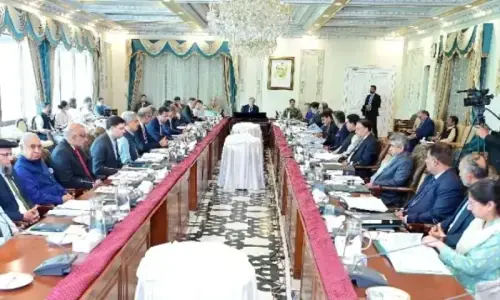
ISLAMABAD, April 20: Prime Minister Mir Zafarullah Khan Jamali said on Tuesday he hoped that ratifications of UN Convention against corruption would help Pakistan in bringing back looted money deposited in offshore banks.
"The government would seriously consider the ratification of the UN convention and incorporate them in government laws," he said while inaugurating an international conference on UN Convention Against Corruption at a local hotel.
The prime minister stressed the need to stop any sort of arbitration in corruption cases to ensure a corruption-free society. However, he did not elaborate what sort of arbitration he had in mind.
"Whether the accused are politicians or others, arbitration should not be done in corruption cases as arbitration in such cases is itself a part of corruption, rather more dangerous than corruption," he said.
He said everybody should be accountable for his deeds. The three-day conference is being arranged by the National Accountability Bureau (NAB). The prime minister urged the UN to play its effective role to rid corruption-riddled societies of the menace. "I ask UN what's happening and what happened around the world and why people kept there eyes closed," he added.
Mr Jamali said every democratic government extended political patronage to its workers, but called for drawing a line between patronage and political corruption. "This sort of patronage can be seen in many countries like the US, the UK, Germany, India, Bangladesh and others," he added.
He lauded the United Nations Convention Against Corruption as "a great leap forward" that would help developing states retrieve their plundered assets. NAB Chairman Lt-Gen Munir Hafiez and UN representative Dimitri Vlassis also spoke on the occasion.
Pakistan is among the 15 countries which signed the Convention in Mexico in December last year. Since then the number of signatories to the document has reached 106. The prime minister billed the convention as a comprehensive exercise which would cover issues ranging from preventive measures, criminalization, international cooperation, asset recovery to technical assistance and information exchange.
He referred to certain clauses of the convention which, he said, were more relevant to the problems being faced by the developing countries - foremost amongst them would be the issue of assets recovery.
He said siphoning of these much-needed resources has had an adverse effect on sustainable economic, social and political development of countries, curtailing a government's ability to even provide basic essential services.
Mr Jamali said the convention deals with the issue in detail, and hoped that it would prove to be instrumental in having the plundered assets returned to the victim states. The convention has also made a pioneering effort by binding signatories to render specific forms of mutual legal assistance in gathering and transferring of evidence.
Speaking on the occasion, NAB Chairman Lt-Gen Munir Hafiez said the bureau had been deriving strength from the government's commitment to fight corruption. He said corruption has continued to be a bane for development, and added caging this menace would help the fight against many social problems, like drug and human trafficking. He called for bridging the North-South divide to overcome this global phenomenon.