0
0

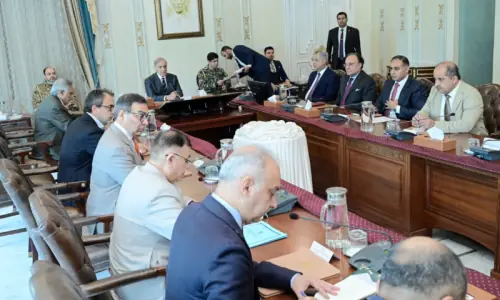
KARACHI, Feb 1: The National Credit Consultative Council has revised key monetary targets for the current fiscal year anticipating that both GDP and inflation may grow faster than targeted.
The Council that met under the chairmanship of State Bank Governor Dr Ishrat Husain at the SBP headquarters here on Tuesday revised monetary targets anticipating that GDP as well inflation both would rise by more than 7 per cent during this fiscal year. Initially, the government had projected 6.6 per cent growth for GDP and 5 per cent increase in inflation.
The Council revised upwards the target for private sector credit to Rs350 billion from the initial Rs200 billion, according to a press release issued by the SBP. During the first half of the fiscal year, the private sector credit has already expanded by Rs285 billion.
Whereas the Council increased the private sector credit target, its chairman Dr Ishrat Husain advised banks "to discourage large syndicated loans and encourage companies with big names to raise funds either in the domestic TFC (term finance certificates) market or in the international capital market."
He made this advice to ensure that more bank credit was available for the small and medium enterprises and agricultural sectors. He also advised banks "to empower the middle class by giving it the opportunity to borrow funds for housing, consumer durables and other micro loans essential for poverty alleviation."
Dr Husain informed the Council that 23 per cent of the total bank credit given during July-December 2004 "had gone to the small and medium enterprises." The Council also increased the target for net government budgetary borrowing from banks to Rs60 billion for this fiscal year, says the press release.
The initial target was Rs45 billion. It also increased the growth target of broad money to Rs360 billion or 14.48 per cent from Rs280 billion 11.26 per cent. Earlier, the SBP chief gave an overview of the monetary and credit developments in the first six months of the current fiscal year.
He informed the Council that credit expansion has been quite high in the private sector and broad-based as it has led to expansion of almost all industries. Private sector credit expanded by Rs285 billion, in the first six months of the current fiscal year.
Manufacturing sector received 52 per cent of the total credit while commerce, transport & communication, and services sectors got 26 per cent. Within manufacturing sector, all-important sub-sectors were the beneficiaries, particularly the textile sector.
In addition, a significant growth in consumer financing, including auto-finance and housing was observed. He said that it is imperative to encourage these sectors as the benefits of this credit go to the middle-class of the society which was deprived of access to bank credit in the past.
Further, these sectors have strong linkages with employment and other domestic sectors, which help maintain the current growth momentum, besides enabling the economy to surpass the economic growth target of 6.6 per cent.
The Council was informed that the growth of broad money (M2) has resulted mainly from the expansion in the net domestic assets (NDA) of the banking system during the first half of fiscal year 2004-05.
The credit to private sector was the driving force behind the expansion in the NDA. The government budgetary borrowings amounted to Rs24 billion while the Public Sector Enterprises continued to show improvement as their net credit retirement totalled Rs9.8 billion.
The net foreign assets (NFA) of the banking system showed an expansion of Rs8.1 billion. Earlier, the Agriculture Credit Advisory Committee met under the Chairmanship of SBP Governor Dr Ishrat Husain and reviewed the situation in respect of agriculture credit in the country for July-December 2004.
The Committee noted that on the basis of the actual results of the first six months it is most likely that the target for agriculture credit by the banks of Rs100 billion originally fixed for 2005-06 will be achieved by June 2005 -- one year ahead of its stipulated date.
The banks have already disbursed Rs49.1 billion in the first six months against the year end target of Rs85 billion recording an increase of almost 50 per cent over the corresponding period in the previous year.
The Committee also noted that the domestic private banks had already exceeded their annual target while the big five commercial banks had achieved 63 per cent of the target.
Together the commercial banks have increased their share to 58 per cent of the total agriculture credit disbursements. It may be recalled that in 1999-2000 the commercial banks were providing only Rs9 billion or 23 per cent of the total disbursements to the agriculture sector.
The performance of commercial banks in recovery was also quite impressive as they had already realized 83 per cent of recoverable amounts from the agriculture borrowers.
Subsistence farmers (owning land less than 12.5 acres) received almost 65 per cent of the total agriculture loans followed by economic holding farmers (between 12.5 and 50 acres) whose share was 20 per cent.
The Committee also has begun tracking credit to livestock sector separately from the crop sector. The disbursements for livestock, poultry and dairy have reached Rs4.5 billion or 9 per cent of total loans.
Among the uses of credit, fertilizer purchase accounted for 42 per cent of all loans in this six month period. The banks also financed 10,318 tractors during this period.