0
0

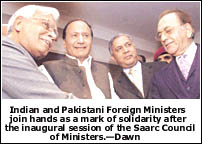
ISLAMABAD, July 20: The 25th session of the Saarc Council of Ministers opened here on Tuesday amid emphatic calls to resolve political disputes in the region to enable the association to achieve its goal of poverty alleviation and development.
At the inaugural ceremony both Prime Minister Chaudhry Shujaat Hussain and Foreign Minister Khurshid Mehmood Kasuri underscored the need for the Saarc leadership to resolve political differences.
The dominant themes of the session were greater cooperation in South Asia, peace, prosperity, progress and stability in the region. It was marked by references to the 12th Summit in Islamabad as being a major milestone in the history of Saarc, heralding a new era of mutually beneficial cooperation.
In his brief but compelling inaugural address, the prime minister made a direct reference to Kashmir, noting that Pakistan under the leadership of President Pervez Musharraf had "embarked upon making a meaningful effort to resolve all differences and disputes, including the issue of Jammu and Kashmir".
Expressing satisfaction over the resumption of Pakistan-India dialogue, he held out the assurance to all Saarc member states and the world community that Pakistan was committed to pursuing peace with India.
While recounting that the 12th Saarc Summit had paved the way for enhanced cooperation among the member states, he emphasized: "It is the responsibility of our collective leadership to find practical solutions to the problems faced by our people in their daily lives."
The prime minister advocated 'creative solutions' to the challenges faced by the region and said: "Let us resolve today that Saarc must become a symbol of peace and progress not only to ensure stability in South Asia but also to win hearts and minds of the people of this region by being their voice and their great hope."
He maintained that despite numerous challenges Pakistan had tried to make a meaningful contribution in turning Saarc into a 'success story'. The prime minister called upon the Saarc members to pay special attention to developing transport and communications infrastructure in order to promote greater regional cooperation.
He hoped that the Saarc foreign ministers' meeting would lead to cooperation in the fields of information technology and telecommunications. Referring to efforts for establishing a South Asian development bank, he hoped that it would accelerate economic activities in the region. He expressed satisfaction over the progress made on operationalizing the agreement on South Asian Free Trade Area (Safta).
In a significant observation, Prime Minister Shujaat specifically welcomed China's interest to associate itself with Saarc. "I am pleased to learn that the People's Republic of China has expressed its interest to associate closely with Saarc.
This is a very welcome development," he declared. This was the first public pronouncement at the highest political level, acknowledging and backing China's interest in the regional body.
KASURI: Foreign Minister Kasuri, chairperson of the council, in his welcome address, declared that today an air of hope and optimism prevailed in the region. He emphasized that South Asia, which is home to one-fifth of the humanity, must join the Asian fast track to development, noting that the centre of economic gravity was shifting to Asia.
He, however, cautioned: "The vision of South Asia joining the Asian mainstream to fast economic growth can only be realized if there is peace and harmony." In this context, he said, the resumption of composite dialogue between Pakistan and India was a welcome development.
"We are committed to making this process a success. I have no doubt that this augurs well for Saarc and over 1.4 billion people of this region," he asserted. His passionate plea to the members of Saarc was: "In visualizing Saarc's future, we must give serious thought to devising ways and means whereby political differences and disputes within the region are settled amicably."
He added: "Saarc must become the symbol of our resolve for economic development, preservation of our environment and above all, an instrument for ensuring social equity and justice for all."
Referring to the Social Charter adopted by the 12th Summit, Mr Kasuri said Pakistan had given special attention to Saarc activities for promoting the role of women in development.
Pointing to Pakistan's proposal of setting up a South Asia energy forum and a Saarc energy centre, he maintained: "This would bring great dividends to all member states by ensuring that their energy needs, that are critical for development, are met in a secure and cost-effective manner."
Mr Kasuri underlined the need for Saarc to forge cooperative partnerships with relevant international financial institutions, other regional organizations and states that have the capacity to contribute to development.
Later, Saarc Secretary-General Q.A.M.A. Rahim, gave a run- down on the significant progress made on decisions of the 12th Summit. Terming the summit a turning point in the evolution of regional cooperation in South Asia, he revisited the three historic documents signed during the summit, namely Safta framework treaty, Social Charter, and Additional Protocol to the Regional Convention on Suppression of Terrorism.
On behalf of all Saarc members he commended the government of Pakistan for the leadership it had provided to the association in its capacity as the current chair.
KASHMIR: Talking to reporters later, Mr Kasuri said the onus of resolving the Kashmir dispute rested with the political leadership of both the countries. His loud and clear message was that unless the leadership on both sides showed courage and took bold steps the Kashmir issue would remain unresolved for another 57 years.
"Ultimately it is the responsibility of political leadership, not the bureaucrats, and what it requires is political will," he maintained. He asserted that the Pakistani leadership had demonstrated its willingness to take such steps, implying that the ball was now in India's court.
In reply to a question, Mr Kasuri said he was confident that the new Congress-led government in India was committed to the ongoing peace process with Pakistan.