0
0

ISLAMABAD, July 19: Foreign Secretary Riaz Khokhar took up the issue of Srinagar-Muzaffarbad bus link and Pakistan's proposal of setting up a joint expert group on conventional CBMs during a bilateral meeting with his Indian counterpart Mr Shashank here on Monday, it is learnt.
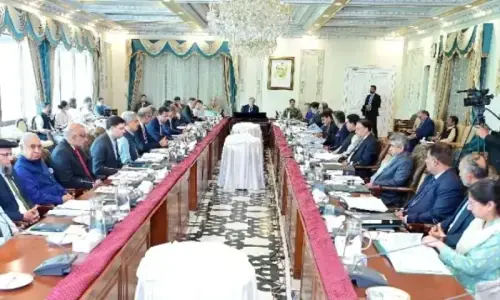
The meeting that took place between the two foreign secretaries and their delegations on the sidelines of the 30th session of the Saarc Standing Committee was characterized as 'informal' by the Foreign Office.
Important matters were discussed during the 90-minute meeting. The talks over a breakfast meeting were described as 'candid' and the attitude of both the delegations remained positive.
Indian foreign secretary-designate Mr Shyam Saran, India's High Commissioner to Pakistan Mr Shivshankar Menon, Pakistan's High Commissioner to India Mr Aziz Ahmed Khan and senior Pakistani and Indian officials were present at the meeting.
During the meeting Pakistan conveyed to the Indian delegation its keenness to start the Srinagar-Muzaffarabad bus service, sources said, adding that Pakistan underscored the importance of the bus link to the Kashmiris divided on the two sides of the Line of Control (LoC).
The Indian delegation raised issues regarding modalities of such a service. While formal talks are to be held to sort out the modalities, Pakistan's foreign secretary conveyed Pakistan's position on the composition of Indian delegation at the talks as well as Pakistan's position on travel documents.
To iron out issues preventing the two sides from initiating formal talks on the bus link, Pakistan's foreign secretary proposed that the joint secretaries of India and Pakistan could meet for preliminary discussions.
According to sources privy to the talks, Mr Khokhar reiterated Pakistan's position that a two-step approach to addressing the bus service talks was required. One, an overall agreement between the governments of India and Pakistan on the framework and modalities for the bus service was required.
Two, following such an agreement the next step would involve technical questions regarding who would run the service and the frequency of the service. This point has become particularly important given the Srinagar-Muzzafarabad bus talks have been twice postponed because of Pakistan and India's disagreement over the composition of the Indian delegation.
India had proposed the names of its Indian Administrative officers belonging to Jammu and Kashmir state cadre. Given that Pakistan does not recognise Jammu and Kashmir as part of the Indian Union, it has let India know that Jammu and Kashmir representatives cannot be received as part of the Indian government's delegation.
Jammu and Kashmir representatives would however be the logical choice for inclusion in technical-level talks where the role of Jammu and Kashmir state and the Azad Jammu and Kashmir government in running and managing the bus service would be obvious.
Sources said India did not agree to Pakistan's position, maintaining that Jammu and Kashmir officials have been received by Pakistan in the Baglihar Dam talks. Pakistan government, however, argued that the Baglihar talks were conducted in accordance with the Indus Waters Treaty, which calls for officials managing the projects related to the treaty.
Hence, the inclusion of representatives from Jammu and Kashmir state where the dam is being constructed would be inevitable. The Pakistani side again clarified that travel across the LoC could take place using state documents issued by the Jammu and Kashmir and Azad Jammu and Kashmir governments, sources told Dawn.
It also emphasized that the use of passports and issuance of visas would not be acceptable given that LoC is a temporary line across the disputed territory and not an international border between India and Pakistan.
Another important issue that figured in the bilateral meeting was Pakistan's repeat suggestion to set up a joint working group on conventional CBMs. This was a proposal that Pakistan had made during the foreign secretary-level talks in New Delhi last month in response to a long list of conventional CBMs proposed by India.
On the question of mandate for such a group the Pakistani delegation said that it would review progress that had taken place on the conventional CBMs proposed by the two countries over the years.
Foreign secretary Riaz Khokhar told reporters at a news briefing that during the bilateral meeting the two sides had very carefully "revisited" their talks in New Delhi. He was evasive when asked if any specific proposals had been discussed, saying that the two sides had "come up with some ideas" that would be discussed by the foreign ministers.
A Foreign Ministry statement said: "The two foreign secretaries reviewed the movement in the processes of composite dialogue and confidence building. They expressed satisfaction over the commencement of the talks between the foreign secretaries on peace and security and Jammu and Kashmir, held in New Delhi in June 2004." It added: "They also discussed follow-up on agreed nuclear CBMs and further explored enhancement of CBMs in the field of communication."