



 0
0

The function of redistribution of income is assigned to central or federal governments, and not to provincial or local governments, for several reasons.
The first reason is that any attempt made by a provincial or a local government within their geographic jurisdiction aimed at redistribution of income may drive at the factors of production from there to another provincial or local government jurisdiction. It will, thus, distort geographic allocation of resources.
The second reason is that assignment of this function to a province or a local government may lead to a fiscal war among provinces for attracting factors of production to their jurisdiction.
The third reason is that horizontal economic imbalances among the provinces and local governments can only be addressed by national policies. The fourth reason is that monopoly of production of an item and it's pricing being in control of a province or local government can much affect incomes of citizens living in other provinces or districts.
For the reasons enumerated above, the function of redistribution of income has remained under the jurisdiction of the federal government in Pakistan. However, there is a lot of disenchantment among the people with regard to the efficiency of the federal government in acquitting this function.
In fact, the policies of the government have contributed to greater concentration of income, widening the gap between the "haves" and "have-nots". The one most commonly used measure of income disparity is Gini ratio.
It's value ranges from 0 to 1 with 0, representing perfect equality with each percentile of house-hold getting the same income and I representing perfect inequality with one income class getting all income and others getting nothing.
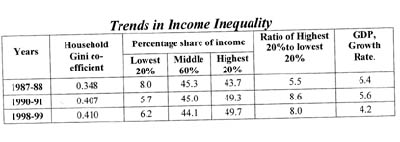
The table below sets out a growing income disparity in Pakistan over past one decade. The above table amply demonstrates that income inequality continued to widen over time with the share of lowest 20 per cent income class sliding down from 8.0 per cent in 1987-88 to 6.2 per cent in 1998-99 and those of the highest 20 per cent income class going up from 43.7 per cent to 49.7 per cent.
It is interesting to note that the share of 60 per cent middle income group also declined from 45.3 per cent to 44.1 per cent - a sure sign of growing concentration of income in the hands of 20 per cent highest income group.
This confirms that economic growth only benefited those parts of population who fall in the category of 'haves', leaving the majority of population behind. Pakistan has developed Poverty Reduction Strategy Paper which underscored the need for continuous monitoring of impact of measures contained in the PRSP.
However, following the merger of the Household Income and Expenditure Survey into Pakistan Integrated Household Survey in 1998-99, only one combined report of PIHS had come out in 2001.
This may be on account of a lurking fear of managers of the economy of exposure of further deterioration in income inequality, following a rising trend in incidence of poverty as measured by Head Count Ratio.
According to the Economic Surveys of 2002-03 and 2003-04, population living below the poverty line was 32.1 per cent in 2000-2001 as against 26.1per cent in 1990-91 and 30.6 per cent in 1998-99.
The Economic Survey 2003-04 seems to controvert official number of poor at 32.1per cent cited by the Survey at page 42 by lowering the incidence of poverty at 27.30 per cent for the same year at page 43, based on a limited survey and goes on to establish a decline of 4.2per cent in incidence of poverty in the year 2003-04! It is also interesting to note that the incidence of poverty is based on the officially notified line of Rs. 748.56 per capita per month at 2000-01 prices as against internationally accepted yardstick of treating population as 'poor' which earns less than one U.S dollar a day i.e. less than Rs.1740 per month.
Nonetheless, the result of limited survey can hardly be relied upon which contradicts the official incidence of poverty at 32.1 per cent based on PIHS report for 2001 which the Survey itself admits as " the last estimates available in the country".
It can, therefore, be safely assumed that poverty incidence has increased and with it income inequality. One will not be wrong in concluding that the fruits of growth have largely accrued to a "privileged class".
In other words, the policies have contributed to creating an enabling environment for this privileged class to reap maximum benefits of growth instead of making a deliberate and directed attempt to redistribute income and thereby reduce poverty.
The policies pursued stand in conflict with the strategy spelled out in the Poverty Reduction Strategy Paper which states that "the development challenges for Pakistan include achieving high and sustained broad based economic growth particularly in rural areas, reducing poverty, providing essential services and infrastructure to the poor creating job opportunities and improving governance".
Had the policies been framed in the prism of this strategy, the outcome could be positive. Unfortunately, it is not. Absolute poverty has grown and income inequality has widened as already discussed.
Unemployment rate which stood at 6 per cent in 1999-2000 has soared to 8.27 per cent in 2003-04. In the absence of PIHS latest report after 2002, it is difficult to say if there has been any significant improvement in the human development indicators. However, the results based on PIHS survey, 2002 are, neverthless, not encouraging as set out in the table below:-
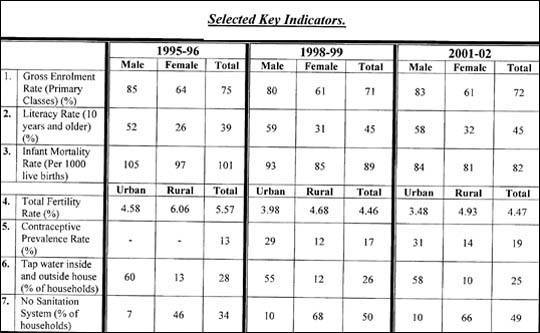
The growth in the economy, as such, does not conform to the standards of quality of growth. It is ruthless growth for poverty has shot up and income inequality widened; it is jobless growth because unemployment has increased and it is voiceless growth for empowerment of people via human development lags behind.
While presenting the budget, 2004-05 the finance minister in his budget speech has tacitly admitted that redistribution of income from growth in the economy was not in focus by stating that "so far the focus of reforms was to achieve macro- economic stability as we had inherited a declining and volatile economy. The process of reforms will have to be accelerated and advanced to the second generation of reforms".
The budget speech in totality covers a wide spectrum of second generation of reforms such as poverty reduction, human development, good governance, competitive environment etc.
One does hope that second generation of reforms that he has talked about so forcefully will not lose its direction - direction towards amelioration of the lot of preponderant majority of population which lives in abject poverty and deprivation.





























