0
0

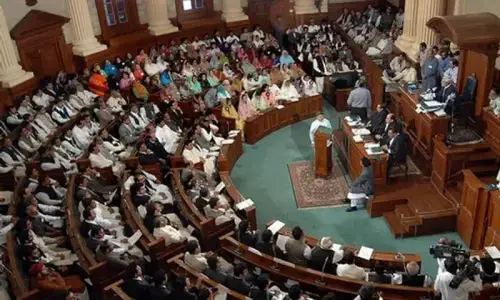
LAHORE, July 7: Speakers at a seminar have expressed their grave concern over the deteriorating law and order situation in the country and called upon the government to take urgent measures to this effect.
The seminar was held here on Wednesday by the Hamdard Thinkers Forum at the Hamdard Centre with Senator S.M. Zafar in the chair. In a resolution, the forum said that it was the foremost duty of the government to provide security to the people.
The federal and provincial governments should take stock of the law and situation and frame a joint policy to combat the increasing incidence of terrorism and crime.
It said that main causes of lawlessness and terrorism were economic disparity among the people, which had made the rich richer and the poor poorer and the subversive activities of the enemies of Pakistan who hire local people for terrorism. Taking stringent measures against the saboteurs could check these activities.
The resolution also welcomed the recent talks between the government and the MMA leadership on the law and order in tribal areas. Addressing the meeting, Senator S.M. Zafar said besides taking strict measures to improve the law and order situation, the government should take measures to remove the economic disparity and poverty, which had assumed an alarming proportion in the country.
He said the Britishers had given top priority to internal security and justice to the people during their colonial rule in the sub-continent. It needed a strong police force and strict accountability of the offenders.
He also emphasized the need for the rule of law, the supremacy of the Constitution for the economic and political stability. Lahore High Court Bar Association president Ahmad Awais lamented that scant regard was given to the observance of rule of law in the country and the law of the might had replaced it.
He said observing the rule of law could control terrorism and crime and everybody should be answerable to law. It would need a strong judiciary and strict system of accountability.
He said the political stability and economic strength were as much essential for a country as nervous system and blood circulation for the human body. The poor law and order, terrorism and absence of rule of law had adversely affected the political and economic stability of the country.
He said the wealth of the most of the illiterate Pakistani immigrants dispatched to the country had created artificial status of life, which had given rise to most of the social ills in the society.
Dr Rafiq Ahmad said a strong leader like Imam Khoemini of Iran was required to introduce reforms in Pakistan. He said ambitious policies were framed but these were not implemented.
He suggested that the federal and provincial governments should frame coordinated policies to ensure peace and harmony, combat terrorism and crime, speedy justice and employment to the jobless.
Former provincial minister Brig Hamid Saeed Akhtar (retired) said while the government had taken measures to improve internal security which would ensure both local and foreign investment, the law and order situation in the country, particularly in Karachi had been far from satisfactory.
He alleged that some subversive elements of a neighbouring country were mostly responsible for worse conditions in Karachi. He said in Karachi he found a highly objectionable pamphlet against Hazrat Ali printed at some unknown press for circulation among the Shia community.
On investigation, he discovered that the pamphlet had been written by a Hindu and printed by him. He said horrible crimes had been committed by the members of a political party which had been controlled with great difficulty by the PPP government by taking stringent action against them.
Chaudhry Bashir Ahmad and Humayun Ehsan advocates said outlaws in connivance with the police committed 50 to 80 per cent of crime. Mr Ehsan said persons with bad reputation and having criminal cases against them had been given high positions in the government. Other speakers included Dr Maskeen Hijazi, Prof Abdul Jabbar Shakir, Dr M.A. Soofi, and Nawaz Malik.