0
0

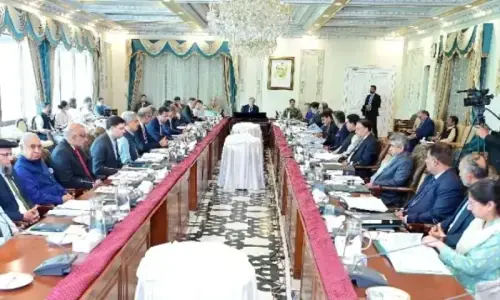
ISLAMABAD, April 16: Amid Sindh's demand for an independent National Finance Commission (NFC), the federal government on Friday offered to increase the provinces' share in the divisible pool to 47 per cent but the latter remained firm on their joint demand for a 50 per cent share.
Finance Minister Shaukat Aziz, who presided over an 'informal' NFC meeting, told newsmen that the federal government had increased the provincial share from 46 per cent to 47 per cent to improve their resource position. This, he said, also included a 2.5 per cent general sales tax.
He did not say what the one per cent increase would mean in monetary terms, but according ton an official, this would be about Rs5.4 billion for 2004-05. Therefore, the provinces' share calculated at Rs250 billion on the basis of 46 per cent would increase to about Rs255 billion.
At 50 per cent, it would go up to Rs272 billion as the federal government estimates the total size of the divisible pool at about Rs545 billion. Mr Aziz said the provincial finance ministers would go back to their governments, chief ministers, cabinets and the assemblies to get a response to the 47 per cent offer and then get back to the NFC after a week.
He gave an impression that the vertical distribution of resources was not the main issue, rather it was the horizontal distribution (among the provinces) which was hindering the NFC award.
All the provinces, however, said that the horizontal distribution of resources was a secondary issue and could be resolved within no time if the centre increased their share. "We can make adjustments with each other (provinces) but we should know the size of the pie first," said Sindh Finance Minister Syed Sardar Ahmad.
NWFP Finance Minister Sirajul Haq said the vertical distribution could be termed the pillars of a building and the horizontal distribution its roof. "Ifyou don't have the pillars, how can you expect the roof." He said the federal government had moved from 45 per cent to 47 per cent, which had made the journey to reach the final destination of 50 per cent easier. He hoped that the next round of the NFC would be result-oriented.
Balochistan Finance Minister Syed Ehsan Shah said that distribution of resources between the centre and the provinces was the foundation and "if we don't have a foundation, we cannot raise the building." He said that differences among the provinces could be bridged. He hoped that the next year's budget would be based on the sixth NFC award.
Syed Sardar Ahmad said Sindh had demanded that Pakistan should have an independent NFC like that of India where it is headed by a former chief of the Reserve Bank of India who sought proposals from all the stake-holders and independent experts before finalizing a binding award.
Meanwhile, officials said that Sindh wanted to have a 75 per cent weightage for population, 10 per cent for revenue, 10 per cent for inverse population density and five per cent for backwardness.
Balochistan wanted an 80 per cent weightage for population, 10 per cent for IPD, and five per cent each for revenue and backwardness. The NWFP demanded 80 per cent for population, 19 per cent for backwardness and one per cent for IPD.
Punjab said that unless the federation increased the provincial share, it could not present its weightage preferences but agreed to give a reasonable weightage to other factors.
A provincial minister wanting not to be named said the centre offered Rs255 billion to the provinces on the basis of 47 per cent share while they wanted it to be Rs272 billion. An agreement could be reached somewhere around Rs260 to 265 billion, he said.