0
0

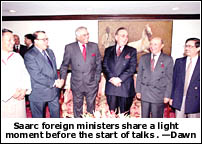
ISLAMABAD, Jan 1: Foreign Secretaries of the South Asian Association for Regional Cooperation on Thursday conluded the 29th session of the standing committee with an agreement on the text of the Additional Protocol to the Convention on Suppression of Terrorism as well as the Social Charter.
Pakistan Foreign Secretary Riaz Khokhar told a news briefing that the standing committee session made a signafant progress on the South Asia Free Trade Area (Safta) framework treaty. The text of the Additional Protocol agreed to covers the aspect of terrorism financing.
"We are very positive about achievement in the Social Charter, Additional Protocol on terrorism and hope differences on South Asian Free Trade Area (Safta) would be sorted out," Mr Riaz Khokhar, who is also the Chairman of the Standing Committee, said.
"The decisions were taken swiftly and discussions were very constructive and interesting," the foreign secretary said. Conceding that there had been some difficulties, he said the attitude of most delegates was very constructive and the spirit to find a solution to whatever impediment came in the way prevailed.
Mr Khokhar announced that there had been significant progress on updating the Regional Convention on Suppression of Terrorism, saying the committee had cleared its Additional Protocol. He said the text would be submitted to the Council of Ministers when it meets here on Friday.
In reply to a question the foreign secretary said the committee did not engage in the exercise of defining terrorism, noting that even the UN for decades had not been able to reach a consensus on the matter.
When asked how the gap on the definition of terrorism could be bridged, particularly with reference to Pakistan and India, Mr Riaz Khokhar said: "We are not in the business of building bridges if there is a gap, all are welcome to keep their own interpretations on the subject."
Reiterating Pakistan's commitment to the Regional Convention on Terrorism, he categorically stated: "While we are mindful of our obligations of combating terrorism in all its forms and manifestations, we will not compromise on our vital national interests."
On the Safta framework treaty, Mr Khokhar maintained while there was significant progress, negotiations were continuing. Referring to differences he said they were now amenable to solution, adding that he was hopeful the negotiations would yield positive results.
He underlined that all Saarc countries were committed to the concept of free trade. "I am hopeful by tomorrow (Friday) the differences (on Safta) will be sorted out," he declared.
In the context of economic cooperation, the foreign secretary said the committee had proposed that the Saarc finance ministers consider the feasibility of a South Asian Development Bank. The Committee on Economic Cooperation, he said, would give special attention to matters of transit facilities and transport infrastructure.
He said the standing committee also approved the report on the Independent South Asian Commission on Poverty Alleviation, saying: "We are integrating the recommendations of the Commission in our national poverty alleviation programmes and giving a special advocacy role to the Commission."
He made it clear that while the Saarc Secretariat would collaborate with the UN and other international organisations, Saarc member states would remain the monitoring authorities.
The foreign secretary said the text of the Social Charter, that addresses the social issues, would be submitted to the Council of Ministers for approval. Other areas that were covered by the Standing Committee in the social domain included preventing and combating trafficking in women and children, promotion of child welfare and voluntary fund for disabled people, he added.
Responding to queries about the prospects of a request from New Delhi for Prime Minister Vajpayee's one-to-one meeting with President Pervez Musharraf during the former's visit here this week, the foreign secretary said: "We are not begging or soliciting, we are the host."
He was quick to point to a culture of diplomacy that demanded visiting leaders call on heads of host countries during multilateral conferences.
The Indian Prime Minister is the only Saarc leader who has not yet requested for a meeting with President Musharraf or Prime Minister Mir Zafarullah on the sidelines of the 12th summit conference.
Later, when Dawn asked the foreign secretary if Pakistan would be disappointed if no request came from India for a bilateral meeting, he did not give a direct answer. "Do I look disappointed?" he asked with a meaningful smile.