0
0

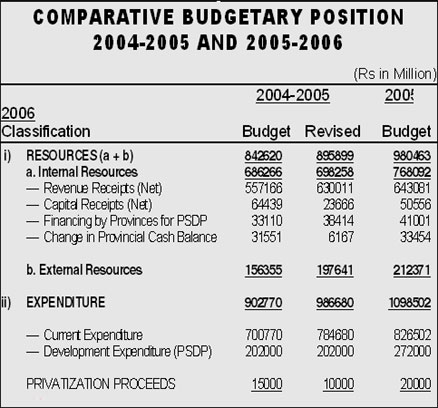
KARACHI, June 6: The government says it will borrow Rs98 billion in the next fiscal year to fill in the gap between incomes and expenses.
Budget documents released on Monday show that Rs98 billion borrowing for the fiscal year 2006 would be substantially larger than that of about Rs80.8 billion for the year 2005.
What has forced the government to set such a huge target of bank borrowing for the next fiscal year is that it has been unable to generate enough resources through non-bank borrowing. This also explains why its bank borrowings will rise to Rs80.8 billion during this fiscal year from the revised target of Rs60 billion. Between July 1, 2004 and May 21, 2005, the government has already raised Rs38.5 billion through bank borrowings.
Now if the total borrowing is estimated to reach Rs80.8 billion by the end of the fiscal year in June it means the government would speed up bank borrowing during this month.
The latest decision by the State Bank to sell treasury bills of all three tenures would help the government increase bank borrowings swiftly without letting interest rates rise too fast.
On Monday, the central bank announced it would hold the first joint auction of three-month, six-month and one-year T-bills on Wednesday. It said it would sell Rs77 billion worth of these bills.
When the SBP had informed banks last weekend that it was going to hold the joint auction of treasury bills of all the three tenures, central bankers thought it would make interest rates stable. But as the government has now announced that it would be borrowing Rs80.80 billion from the banking system during this fiscal year, up from the revised target of 60 billion, and that its borrowing in the next fiscal year would be even larger -— Rs98 billion —- it would be difficult for the SBP to keep interest rates stable.
Bankers say when the government’s growing appetite for funds is known banks would be tempted to make expensive bids for T-bills. That in turn, would leave the SBP with no other option but to increase the yields on TBs a bit higher than what is desirable. They say the central bank may choose to raise the yield on TBs of a particular tenure higher than the other to streamline the yield curve but on the whole it will not be able to suppress the demand for higher T-bills yields.
Besides, it would not be feasible for the SBP to increase the yield on TBs of exactly the same tenure that it thinks should move up. At times, they will have to allow an unwanted rise in TBs yield just to help the government meet its higher borrowing targets.
What forces the government to end up with Rs80.8 billion bank borrowing during this fiscal year is that its borrowing through fixed-income national saving schemes is set to remain negative. In nine months of this fiscal year i.e. between July and March 2004-05, net investment in the NSS stood at minus Rs10.8 billion. In other words, the government had to return Rs10.8 billion during this period to those who had invested in the schemes instead of raising additional saving through these schemes. Another reason that compelled the government to rely more on bank borrowing during this fiscal year was that it failed to raise debt through long-term Pakistan Investment Bonds.
Part of the funds raised through PIBs falls in the category of non-bank borrowing i.e. if the investors are corporates and non-bank institutions. But as the government refused to raise the effective yield on these bonds, corporate buyers remained aloof and are still watching from the sidelines if there is any move to let the long-term bonds offer realistic rates of return.
Currently the coupon rates of three-year, five-year and 10-year PIBs are six, seven and eight per cent, respectively, lower than or equal to three-month, six-month and one-year treasury bills.
Bankers say if the government’s borrowing from the banking system is going to reach Rs80.8 billion during this fiscal year, the central bank will have to increase the yields on three-month, six-month and one-year bills by up to one percentage points in each case before the close of this fiscal year. As for the next fiscal year, they say, that meeting the bank borrowing target of Rs98 billion would keep TBs rates moving up -— at times beyond the expectations of the State Bank —- unless the government increases its non-bank borrowing from the NSS and PIBs.