0
0

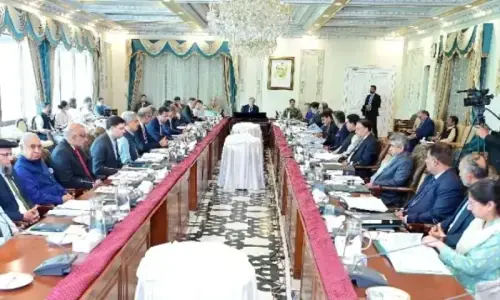
ISLAMABAD, Dec 3: The parliamentary committee on national security on Wednesday saw some “anxious moments” when some of its members exchanged harsh words on the government’s “reluctance” to order the Air Force to stop drone attacks in tribal areas.
The committee, which held a nine-hour brainstorming session, was later adjourned to Dec 16.
Mian Raza Rabbani, who presided over the meeting, came under pressure and offered to resign as chairman after he was criticised by colleague Babar Awan, sources told Dawn.
Some of the members, the sources said, had asked the chairman to invite former president Pervez Musharraf to inform the committee about arrangements Pakistan had with international forces that had “compromised the country’s sovereignty”.
They also criticised the government for allowing the former president to go abroad and said he should have been tried for his eight years of “misrule”.
The government was also criticised for following policies of the Musharraf regime, which was “responsible for killing thousands of innocent people under US dictates”. They stressed the need for holding talks with militants and change of foreign policy.
Defence Minister Chaudhry Ahmed Mukhtar has repeatedly stated that the country lacks technology to check air violations by American drones which, according to him, fly at an altitude of 50,000 feet.
But the PAF chief had recently said the air force had the capability to stop drones from entering Pakistani airspace.
The members challenged the defence minister’s claim, saying the drones usually flew at a low-altitude as tribesmen saw them almost every day.
The government side, the sources said, was not happy with the tone of the question and Mr Rabbani said that this should be avoided in the next proceedings.
ISI Director General Lt-Gen Ahmed Shuja briefed the committee on military operations in tribal areas and some settled areas of the NWFP.
According to the sources, he suggested that the government hold talks with militants because no military solution was possible.
The committee was also briefed by Foreign Minister Shah Mehmood Qureshi and Prime Minister’s Adviser on Interior Rehman Malik.
According to a member of the committee, Mr Qureshi said there was no written agreement allowing the Americans to hit militant targets inside the country.
The sources said that Mr Malik had supported the military operation, terming it necessary to expose the Taliban, Al Qaeda and their supporters.
The committee, formed to oversee and monitor the implementation of the resolution unanimously adopted during a joint session of the two houses of parliamentary, has so far held three meetings.
The resolution called for a review of the policy on “war on terror”.
Information Minister Sherry Rehman told reporters after the meeting that the committee had a very “tough job” to provide guidelines to the government and monitor the implementation of the resolution.
However, she said, it was trying its best to understand the situation before submitting its recommendations to the government.