0
0

 KARACHI, Aug 13: While electricity users in Karachi are facing prolonged load-shedding due to an artificial shortage created by the KESC to save on fuel, the utility is in serious trouble as it has been put on notice by the Sui Southern Gas Company and Wapda to either sign before Sept 1 a draft agreement they have sent it or face discontinuation of supplies, source said on Wednesday.
The disclosure came on a day when the mercury was 29.5 Celsius with 85 per cent humidity amid showers all over the city. Both the SSGC and Wapda have asked the KESC to pay the new commercial rate for bulk users with 10 per cent advance deposit. The sources said the advance would be more than a billion rupees.
The SSGC has also served a similar notice on Wapda and the gas company seems to be serious in its resolve. However, a source said Wapda had not yet sent its draft agreement to the KESC though it may be in the pipeline.
It was yet another day of prolonged and unannounced power outages of more than two hours at least thrice in 24 hours as the utility claimed it was facing a shortage of 300 megawatts.
According to sources, the KESC had shut down Unit 4 of the Bin Qasim Power Plant to cut its fuel cost. Only four units were operational and they use gas for generating power. If the utility is unable to resolve the issue with the gas company, Karachiites might face widespread power outages in September and beyond and the Bin Qasim and other gas turbines may face serious operational problems.
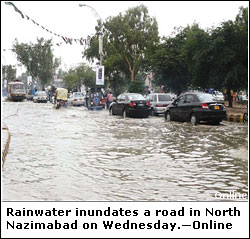
Residents across the city experienced widespread disturbance in power supply, especially after the heavy showers that inundated the low-laying areas although efforts were in progress to clear the choked drains. According to the Met office, the North and New Karachi areas received 35mm of rain while in Landhi 20mm of rain was recorded. At the Karachi airport it was 14mm, University Road 12.6mm, Faisal Base 14mm and Masroor Base 5mm.
Although the wind was not strong, many consumers of the KESC from North Karachi, New Karachi, Orangi, Landhi and Malir complained of broken wires and the KESC’s inability to fix them.
The shortage of electricity had increased in the last 24 hours. A major reason for the widening gap between power supply and generation was the stoppage of power generation input from the Defence Cogen desalination plant also on Tuesday afternoon. Owing to a serious shortfall of electricity, the power utility resorted to load-shedding of two-hour duration in multiple spells on a rotational basis in various residential and commercial localities of the city.
A source privy to the power supply situation in the city said the shortfall of electricity in meeting the overall power supply demand of the city had phenomenally increased due to problems with the Korangi Thermal Power Station (KTPS) and the Bin Qasim Thermal Power Stations of the KESC.
Around 160 megawatts power supply input from the KTPS had stopped on Monday afternoon due to tripping in the system.
Meanwhile, inhabitants of a large part of Gulshan-i-Iqbal, Gulistan-i-Jauhar, Nazimabad, F. B Area, parts of Defence, Shah Faisal, and Malir and Landhi were deprived of electricity for several hours.
The areas of the city where water supply remained affected included Landhi, Korangi, Malir, Baldia, Shah Faisal Colony, Site, Orangi and North Nazimabad.