



 0
0

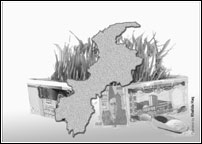 A SURGING wheat subsidy, the soaring cost of security (as military operation picks up in tribal belt close to Peshawar) and increased wage bill are the major financial worries, the NWFP government has to tackle in the current financial year.
The new budget with a total outlay of Rs170.558 billion and a net surplus of Rs345.561 million, has an invisible in-built deficit on different accounts, which will keep haunting the province’s financial managers throughout the year.
The prevailing flour crisis has greatly affected the wheat-deficient province, as it has to feed 27.592 million consumers including 3.9 million tribal and 1.5 million Afghan refugees.
The annual requirement of the province is 3.421 million tonnes, whereas its own wheat production is around one million tones. It has to procure 2.421 million tonnes from outside. It has to rely on Punjab and also imports that increases the cost of the commodity.
The provincial government had been providing subsidy to offset the impact of high cost of wheat flour. It intends to procure 2.05 million metric tonnes of wheat, for which it will need Rs17 billion as subsidy in 2008-09.
Officials say the government has earmarked Rs2 billion in the current budget and still needs Rs15 billion, which it can not generate from its own resources.
They say wheat subsidy is a crucial issue this year because of increase in procurement price by the federal government, an expected shortfall in overall production and restriction on its inter-provincial movement by Punjab. Besides, the market price for wheat is higher than the procurement price.
The NWFP government needs Rs1 billion to extend subsidy in case it maintains strategic reserve stock, which comes to 0.3 million metric tones. Since the situation is not clear, it may have to pay much higher.
The provincial government is taking up the issue with the federal government since the subsidy will equally be shared by the people living in Federally-Administered Tribal Area (FATA) and the Afghan refugees.
“We hope the federal government would help the province in sharing the cost of subsidy,” NWFP Finance Minister Hamayun Khan told the Frontier Assembly in his budget speech. There is no word from the other side so far.
The cost of security in NWFP is going up because of ongoing counter-militancy campaign. Apart from its indirect impacts on provincial economy, the security situation is equally increasing government liabilities.
The government has allocated Rs6.559 billion for the police department, which is 27 per cent higher than the allocation made last financial year.
According to officials, this increase is still insufficient keeping in view the last week’s development in the Khyber tribal region, where security forces are engaged in major operation against local militant outfits.
“This will further increase the cost of security,” opines a senior official at the Finance Department, who says the province badly needs external support.
As usual, the growing cost of administration is a major concern and could be one of the factors contributing towards turning the current surplus budget into deficit.
The budget estimates show that around 45 per cent of the total Provincial Gross Domestic Production (PGDP) will go to wages and pension bills of the provincial government.
Another worrying aspect of the current budget is that the government did not include the amount to be incurred on account of 20 per cent pay and pension raise for the public sector employees in the budgetary estimates.
“This means the current budget already has an inbuilt deficit, which will come to fore later on,” admits another official, saying the provincial government has to keep the wage bill less than four per cent of the PGDP, according to Medium Term Budgetary Framework (MTBF).
Development spending and the public welfare activities are cut in case of rising fiscal deficit as the governments cannot curtail their administrative cost.
The challenges and difficulties are numerous for the ANP-led coalition government, but there are some opportunities as well that can be exploited for generating more resources.
The Awami National Party and the Pakistan People’s Party are sharing power both at the federal and the provincial levels and ideally their working relations should benefit the province in terms of greater cooperation from the centre.
The resolution of long-standing issue of net hydro-electricity profit can help an economic turnaround in NWFP.
A five-member Arbitration Tribunal, headed by Justice (retired) Ajmal Mian, on October 31, 2005, had given unanimous verdict asking Wapda to pay Rs110 billion to NWFP in five yearly installments.
But the public utility challenged the tribunal’s decision in a civil court on December 12, 2006. The NWFP government subsequently moved the Supreme Court, where the case is pending.
Oil and gas production and exploration has proved to be another opportunity for the provincial government to finance its recurrent and development expenditures. The revenue receipts from this source are increasing every year.
For example in fiscal year 2004-05, net receipts from royalty on oil and gas production was just Rs487.271 million, which grew to Rs4.150 billion in last financial year.
It is expected that the revenue on this account will surpass the current year’s estimates of Rs4.429 billion providing fiscal space to the government to finance its overall operations.





























