0
0

ISLAMABAD, May 2: Pakistan on Thursday asked foreign investors to invest in the country as the government was pursing consistent, transparent and open economic policies.
“We are trying to remove irritants which affect business climate...and I do say that we need to do more on removing irritants to make doing business in Pakistan hassle free,” said Finance Minister Shaukat Aziz.
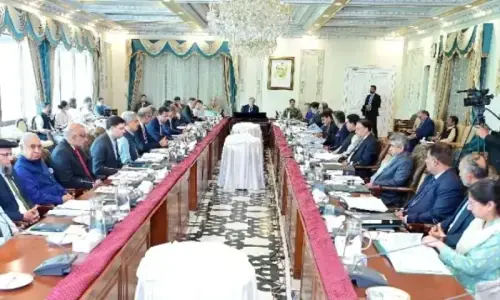
The minister was addressing a day-long international investors conference in Paris — Business Climate and Opportunities for Business in Pakistan — from the World Bank office in Islamabad through video arrangements.
He said that trade and investment regime had been liberalized to attract foreign investment. “We do, however, believe that much remains to be done to improve the investment climate.”
The government, he said, was trying to restructure public sector enterprises for their eventual privatization. “Now the situation is much better than before to disinvest the state sector and I would urge the international investors to come forward and take part in the privatization programme which is very much open and transparent.
“We are undertaking judicial reforms aimed at strengthening the rule of law and enhancing transparency and accessibility of legal system by modernizing the court system,” he said, adding the purpose of these reforms was to improve the investment climate.
He assured the investors that since President Gen Pervez Musharraf had been elected for another five years, there would be continuity in policies and the reform programme initiated about two-and-a-half-years ago.
Since Pakistan is a gateway to the Middle East and Central Asia, foreign investors can establish their industries in Pakistan and export their products to those markets.
Moreover, he pointed out, reconstruction activities in Afghanistan were opening more opportunities for Pakistan to do business there. “Pakistan can be a huge manufacturing market for the export of various products, especially ready-made garments and assembling of electronic goods.”
The minister said that since the business confidence had been restored to some extent, multinationals were operating and investing more money in Pakistan.
He said that Foreign Direct Investment being the single largest component of private capital flows, had contributed to investment and growth in developing countries, leading to reduction in poverty and improvement in the living standard.
“The distribution of these (capital) flows has, however, remained uneven,” Mr Aziz said, adding the countries that had received the lion share of the surge in the FDI flows in the 90s were the ones that had followed open trade and investment regime, maintained macro-economic stability, had large markets, a predictable institutional environment without excessive red-tapism, remained firm in place and possessed reasonably improved physical and human infrastructure.
The countries that lagged behind in attracting the FDI were the ones that had faced macro-economic instability, pursued inconsistent economic policies, had relatively poor physical and human infrastructure, and a bureaucracy not responding to the initiatives with conviction.
Pakistan, he said, had made progress over the last two-and-a-half years. “We have successfully restored our relations with international financial institutions. We acquired high credibility for our reform programmes. We have succeeded in harnessing important resources at home and aboard. We have successfully completed the IMF Standby Agreement, and we have put into motion a broad participative process towards the revival of economy”.
He said the current account balance which remained in deficit to an average of over 5 per cent of GDP during most parts of 90s, was reduced to an average of 2pc during the last two years. At present, it was surplus to the extent of $1.66 billion or 2.8pc of GDP which had helped bring foreign exchange reserves to the level of $5 billion. Remittances have doubled during the first nine months of 2001-02 compared to the corresponding period last year, he added.
The inflation, he said, was at 3pc which was the lowest in the last three decades and stock markets kept rising by more than 500 points or 40pc. Yet another important achievement, he said, was a sharp reduction in fiscal deficit from an average 7pc over the last two decades to 5.2pc last year.
Mr Aziz told the conference that there was no corruption at the top level of government functionaries and added that government was attempting to check red-tapism through civil service reforms.
The conference was jointly organized by the World Bank and the government of Pakistan.