0
0

 The protection of intellectual property rights (IPRs) contribute significantly to GDP, employment, revenues, exports and investment opportunities.
Generally, the impact of IPRs protection on economic growth depends upon the level of a country’s characteristics as reflected in its ability for innovation and imitation. In high-income countries, innovations take place and the IPRs protection encourages further innovation by allowing the innovators to get benefits from their inventions. In case of middle-income countries, imitation can be an important source of technological development but these countries do not engage in innovative activities in a meaningful way..
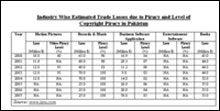
In developing countries, providing IPRs protection to foreign firms could cripple the domestic industry, if it relies significantly on pirated technologies. In low-income countries, IPRs protection is likely to encourage imports and inflows of foreign direct investment. International Intellectual Property Alliance (IIPA) “Special 301 Report”, show reckoned trade losses occurring due to copyright piracy.
Industry-wise estimated trade losses due to piracy and level of copyright piracy in Pakistan
In Pakistan, the system for the protection of IPRs was fragmented in different ministries before 2005. Due to weak IPRs system, different trading countries felt uncomfortable while making investments in research and development activities. To integrate deteriorated IP system, the Intellectual Property Organisation of Pakistan (IPO-Pakistan) was established in 2005 to create investment opportunities, export promotion, consumer’s protection and improvement of the country’s image..
For the TRIPS compliance, it is time to fulfill the terms and conditions within a specified timeframe, such as the enforcement of the agreement under prevailed or amended legislation, institutional development for the implementation of the legislation by utilising the technical expertise..
For foreign investment and transfer of technology, it is necessary to upgrade and strengthen the IP system to protect the IPRs and create an investment-friendly environment.
Being a signatory of the WTO, there is also a need to create awareness among the local business community to fulfill the requirements of integrating global economies which could be possible through active participation of the owners of intellectual property rights, proper and effective treaty compliance, consistent legislations, and appropriate co-ordination among the police, custom agencies, prosecution authorities and the policy departments..
In the initial stages, while implementation of TRIPS agreement, like other developing countries, Pakistan will also have to face several problems, such as the socio-economic costs of adjustment, etc. But in the long run, it is expected that these countries will get benefits through the implementation of TRIPS agreement.