0
0

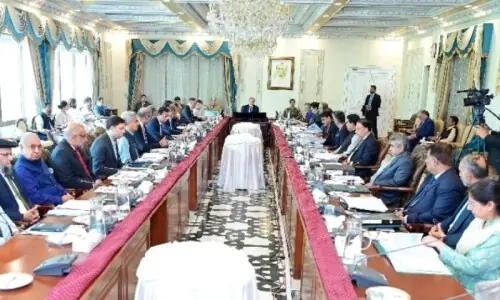
KARACHI, May 3: With the swearing in of 20 ministers on Friday, the Pakistan People’s Party-led Sindh cabinet is slowly but surely reaching the size of former chief minister Arbab Ghulam Rahim’s cabinet.
Chief Minister Syed Qaim Ali Shah’s cabinet now has a grand total of 41 ministers, not including the advisers with the rank of minister (a total of four) or special assistants. With the Muttahida Qaumi Movement officially joining the government of Sindh on Friday, it seems the present set-up is about to match – as far as the numbers game goes – its predecessor.
At one time, the size of Arbab Rahim’s cabinet had ballooned to around 50, including ministers, advisers and special assistants to the chief minister.
As a member of the former government told Dawn on the condition of anonymity, “the (then) opposition had criticised us for forming an ‘army’ of ministers. However, now that they are in power, it seems they are forming an army of their own.”
Though defensive of the move, PPP sources have admitted that political considerations have dictated the hefty size of the cabinet, as not only does the party have to placate its own members, it also has to take along coalition members, which includes an Awami National Party minister who took the oath with the first batch on April 11, and now the MQM, whose 13 ministers took the oath in the second phase of expansion on Friday. The party claims the decision to expand the cabinet is part of its “reconciliation” drive between political forces.
However, analysts have criticised the move, as according to them, it shows a negative trend that has caught on not only in Sindh, but in other provinces as well as the federal level.
Deputy Speaker of the Sindh Assembly Shehla Raza of the PPP told Dawn that the decision to expand the cabinet was made out of respect for the MQM’s mandate as well as to tackle the issues of the province.
“The previous government was also quite large. However, it was part of Mohtarma Benazir Bhutto’s plan to engage the MQM, especially after the May 12 incidents. She wanted to take that party along as long as it disassociated itself from militants. We respect the MQM’s mandate. Plus, it’s better than having to deal with a dictator. The province’s problems are numerous.
“With this, we shall bridge the urban-rural divide and do away with the state of fear prevailing in Karachi. Ministries do not matter much to the PPP. Our priority is peace. We want to show people how politics can be done with an open heart. This is a gift to the MQM and the people of Karachi,” she said.
A PPP source close to the Sindh hierarchy, requesting not to be named, admitted that the spirit of “accommodation” and “political adjustments” necessitated the large size of the provincial cabinet. He also ruled out that there would be any further expansion in the Sindh government.
Dr Syed Jaffer Ahmed, Director of the University of Karachi’s Pakistan Study Centre, felt that a weak political system rather than utility was behind the trend of large cabinets both in Sindh and the rest of Pakistan. “Both at the federal and provincial level, the trend today is to go for bigger cabinets. It’s not that there’s been a great expansion in Pakistan’s resources, which warrants large cabinets. These are political needs and reflect the overall political realities of Pakistan. Now, the consideration is to have a minister from every district. This shows the weakness of political parties and their leaderships.
“I remember in the Ayub Khan era, there were 10 federal ministers, and I can still name them. Today, there are usually over 60 ministers at the federal level. We ask our MA students to name a few ministers and they usually can’t name more than three or four. It reflects a system that is disintegrated. Still, having said that, the worst democracy is still better than a dictatorship,” said Dr Ahmed.