



 0
0

 OIL prices remain an important macroeconomic variable. Higher prices inflict substantial damage on the economies of oil-importing countries and the global economy as a whole. Oil importing developing countries like Pakistan generally suffer the most as their economies are more oil-intensive and less able to weather the financial turmoil wrought by higher oil-import costs.
Majority of our power generation is thermal, with furnace oil, high speed diesel and natural gas as fuels; coal is almost non-existent. As per Energy Yearbook 2007, around 65 per cent power generation in 2006 was from thermal sources; the break-up is 36.4 per cent by natural gas, 28.5 per cent by oil, and coal is only 0.1 per cent.
Majority of our upcoming power projects would be based on oil and gas. According to the PPIB, 23 new projects with cumulative power generation of 5,129 MW have been planned with oil and gas as fuel. This represents our fragile and vulnerable power generation scenario.
Now the furnace oil is touching Rs40,000 per ton and the IPI gas pipeline is hanging in the balance. Even if it materialises one can easily guess the rate of natural gas at which this multi-billion dollar gas pipeline will deliver. Any pricing and supply-chain issue with these fuels can impede the power generation capacity and seriously affect the economy.
Cost of power generation from thermal resources increases every quarter of the year due to fast changing fuel prices. Since tariff of thermal power is heavily dependent on the cost of fuel, it will rise almost with the same ratio the cost of fuel increases. It can be easily assumed that if a new thermal power plant based on furnace oil gets a tariff of 14 US cents per kWh today, it will be around 22 cents per kWh in the tenth year and 34 cents per kWh in the twentieth year. This alone is a frightening scenario. But our regulatory authorities, in a state of dilemma, are knowingly making these expensive power deals.
The brighter side of the picture is that Pakistan is located in one of the most abundant renewable energy resources zone on earth. Whether we talk about hydro with both dam and run of stream projects with sizes ranging from micro hydro project on a canal to large multi-billion dollar mega dam projects, or we talk about power generation by wind blowing moderately well in southern Sindh, Balochistan and northern parts of the country. And last but not the least the potential of solar thermal power projects for which Pakistan presents a very good case, having one of the best solar insulation in the world.
Talking about these three renewable resources one by one, first we take the much discussed about and less worked through resource of hydro energy. Since many decades we have been told by authorities and experts that Pakistan has hydro resource of around 40,000 MW, but unfortunately we are exploiting only 16 per cent of it, a meager 6,500 MW.
Wapda’s vision 2025 indicates that a total of 20,770 MW of new hydro power generation will be added to the system in next 17 years with 14 new projects at a cost of $32 billion. Moreover, the PPIB is also sponsoring 22 hydro projects with a cumulative power generation of 5,720 MW with an estimated investment of $6.5 billion. Some of these hydro projects would provide water storage also. Due to not having enough storage capacity in the country, either we are facing flood or drought, both extremes in the same calendar year. On one hand flood devastates our infrastructure costing us billions and on the other drought increases import bill of essential food commodities; so it is a two-edged sword ripping apart our economy.
Therefore, we should focus sincerely on implementing these 26,500 MW projects and expeditiously search for other mini and micro hydro projects.
Wind: Another renewable resource is the wind energy. However, despite many multi-pronged efforts by the government and the private quarters, the country does not have a single grid connected wind farm on ground.
According to a detailed study conducted by the National Renewable Energy Laboratory, USA (NREL) in collaboration with the USAID and the Pakistan Meteorological Department, the total exploitable wind potential is 132,000 MW. The NREL has prepared solar and wind maps of Pakistan indicating the potential of power and prospective locations of the projects.
The potential wind corridors highlighted for the wind farming are southern Sindh (Keti Bander-Gharo-Hyderabad), northern Punjab (Kallar Kahar), Mardan area in NWFP, Nokundi, Kolpur, Makran and Chaghai areas in Balochistan. By virtue of actual wind measurements and calculations, Pakistan Met Department has defined the potential of only one corridor i.e. Keti Bander-Gharo-Hyderabad as 43,000 MW. One can easily understand if all these corridors added together can go up to 132,000 MW. Only one quarter of this value i.e. 33,000 MW can be attained without a puff of fuel, there can be nothing like this.
The Met Department of Pakistan, after completing six years wind data acquisition project in the coastal areas of Sindh and Balochistan, has launched second phase of the project which will collect imperative wind data in the northern areas. Additionally, the UNDP Pakistan is also planning to install some weather stations specifically for wind data acquisition in some potential areas like northern Punjab, etc. These exercises will definitely pave the way for wind power generation with full government support to the private sector.
For wind power generation, the actual land use is very small as compared to the total area. In fact only 2-3 per cent area is used by the installation of turbines, sub-station and internal wind farm roads. The rest of the area is available for any low height cultivation or cattle grazing. Coincidentally almost all potential wind corridors in Pakistan are situated in barren areas; hence wind farming is the best utilisation of that barren land.
Wind energy is now increasing more than any other power technology in Europe. The world has already seen 95,000 MW wind power projects installed on its face and some concrete plans to enhance this figure to 185,000 MW in 2020 and 300,000 MW before the sun of 2030 sets. European Union is under an obligation that by 2020 they must have at least 20 per cent of their energy needs through renewable resources and wind is among the top choices along with hydro, solar and biomass. EU has also set a binding minimum target of 10 per cent for the share of bio-fuels in overall transport petrol and diesel consumption by 2020. Across the Atlantic, USA is doubling its installed wind power every year, currently standing at 19,000 MW (if it is really called standing).
Why the technologically advanced world is dying for wind power projects? And why we are so reluctant in adopting it?
Investment: It is time to discuss why investors from private sector have not been able to implement wind power projects. First, our policy makers did not foresee the changing technology needs and are still skeptical about it.
Second, for every new technology there is an incubation period. One has to follow a learning curve to gain confidence about the new technology, whether it is the investor or the regulator.
Third, our late start has put us in most unfavorable position to launch the projects. The booming wind market makes it almost impossible to ink a deal with the turbine manufacturers within a three-year period even with hefty advance payments. Apart from turbines, other allied equipment like generators, transformers and HV/MV equipment have long delivery dates. The North American and Chinese markets absorb much of the global production of these equipment. This is a source of frustration for the investors and narrows down their choices.
Fourth is the law and order situation. The turbine manufacturers are now reluctant to come because travel advisories by several countries are adopting a safety-first and wait-and-see approach for the time being.
Fifth, is the GoP policy and the power purchase agreement. Although agencies like AEDB, NEPRA and NTDC have put in lot of efforts to prepare these documents for wind power projects, improvement is required to make them clear and attractive for investors. The government functionaries need to enhance their capabilities through active training and visits to running wind farms, preferably in the European Union and China. Two issues that need immediate attention are the extension of validity date of the Renewable Energy Policy and the ownership of CERs that can be generated through these projects.
Sixth is the problem of availability of land and its lease/sub-lease to investors. Although enough land is available in the wind corridor of southern Sindh, its lease/sub-lease to investors is a very long drawn process. Co-operation and active follow-up by GoP and the Sindh government is essentially required for leasing this land. It will bring in lot of economic and infrastructural up-gradation activities in the area.
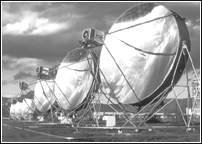
Solar radiations: There are two main techniques of power generation through solar radiation; one is solar PV technology and the other is concentrated solar power technology (CSP). The PV is best suited for stand alone power requirements of homes and offices. Although the world has experience of grid connected solar PV power plants, still it is a kind of domestic business. In contrary, the CSP technology is best suited for grid connected power plants; however, examples of small size captive power generation through sterling dish also exist in this technology.
In addition to power generation, solar energy is also used for heating, cooling and cooking purposes with very simple-to-use technologies. In Pakistan, except some isolated examples, there is no mass scale implementation of these simple technologies. Solar cookers in northern areas can greatly help in saving forests. Solar water heaters in cities can save valuable natural gas. There are many individuals making effort in this field but we have to integrate them for focused efforts and better results.
An area where solar PV can be used on mass scale is the lighting, indoor and outdoor. Indoor lighting meant for offices and homes for which solar PV modules can be coupled with LED lights which require very little electrical energy for the same luminosity and at the same time have very long life.
Alternatively we can use energy saver bulbs. Outdoor lights mainly comprised street lights. It is the time when city fathers should plan and implement a phased change-out of traditional lights with solar PV and LED lights for streets and parks; we can start with alternate light poles, if not all. Housing societies like DHA, Bahria Town, etc., builders like Emaar and Al-Ghurair Giga and the townships of industrial units must also come forward to launch such projects. These projects will trigger local mass production of solar PV modules and LED lights, which will result in low cost of such systems.
Whenever one talks about these renewable energy sources in Pakistan, it is often taken as very expensive, un-reliable technologies. If it is so, why world markets of these technologies are exploding? In fact these renewable technologies are very reliable and are not expensive if the whole lifecycle of the project is taken into consideration.
As earlier discussed a thermal power plant starting the tariff with 14 cents will reach to 22 cents in 10th year and 34 cents in 20th year. In contrary a wind power plant, if started with 14 cents per kWh will continue to be almost the same during first ten years with minor changes due to increase in operation and maintenance (O&M) charges, but with start of 11th year the tariff will drastically decrease to around five cents per kWh and continue to be around the same till the end.
The same is true for hydro and solar with different starting points on the tariff ladder. The energy price of power generated through Wapda hydro facilities is around 0.5 cents per kWh. This is what is called energy security.
Pakistan, therefore, must increase its share of indigenous and renewable resources to reduce dependence on oil imports.





























