0
0

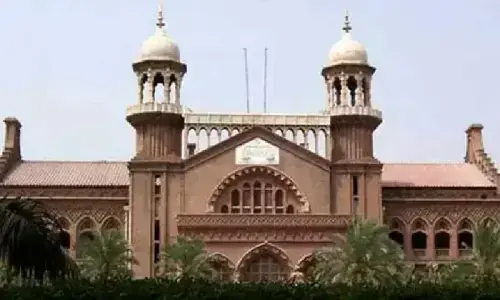
KARACHI, Feb 4: The Sindh High Court disposed of the May 12, 2007, mayhem case on Monday with the observation that the court cannot assume the role of an investigator in exercise of its writ jurisdiction.
The 18-page judgment by a five-member bench, however, ruled that the concepts of ‘aggrieved person’, ‘locus standi’ and ‘judicial review’ under Article 199 had to be assigned a broader and dynamic interpretation to meet the changing requirements of time.
‘Sufficient interest’ of an individual or organisation in a matter is sufficient to invoke the high court’s writ jurisdiction. ‘Sufficient interest’ includes civic, environmental and cultural issues.
The cognisance of the court under Article 199 cannot be circumvented by making a fetish of technicalities. The letter of SHC registrar dated May 21, 2007, could well be treated as an application within the meaning of Article 199.
The registrar had sufficient interest in facilitating the access of judges, staff and lawyers to the court premises and the cognisance could not be construed as a suo motu assumption of jurisdiction. “While the advocate-general (Dr Mohammad Farogh Naseem) may be correct to the extent that under Article 199, this court is precluded from taking suo motu action, the concept of aggrieved person has to be visited liberally, keeping in view the social, political and economic developments,” the bench, which consisted of Chief Justice Mohammad Afzal Soomro and Justices Munib Ahmed Khan, Nadeem Azhar Siddiqui, Abdur Rahman Faruq Pirzada and Rana M. Shamim, observed.
The bench said the access to the high court as to some other areas of the city was admittedly hindered on May 12 but added that the placement of barricades to avoid a bigger conflagration is now an internationally-recognised method of mitigating and averting loss of life and property. Citing Lahore High Court and Indian Supreme Court judgments, the bench said free movement could be restricted to prevent a wider disruption in the public interest.
INVESTIGATIONS BARRED: Referring to the 1971 Supreme Court judgment in Shahnaz Begum’s case against the High Court of Sindh and Balochistan, it said the SC overturned a high court order launching an inquiry into a criminal case which was being investigated by police. In Brig (retd) Imtiaz Ahmed’s case, the Supreme Court held that the effect of registration of a case under Section 154 of the Criminal Procedure Code was to set in motion the investigation process.
The high court, it said, cannot assume the role of investigator. Admittedly, the bench noted, 80 FIRs have been lodged in respect of the May 12, 2007, events. The court can only ask the police to expedite investigations and proceed in accordance with law.
Proceedings seeking to launch an open-ended inquiry would not be permissible under the Constitution and law. The events call for introspection and a resolve by all stakeholders to exercise restraint in the public and national interest in the future.
The bench particularly referred to a Delhi High Court judgment in the aftermath of anti-Sikh riots following Indian premier Indira Gandhi’s assassination in 1984. A petition in the nature of public interest litigation was moved to request the court to investigate the breakdown of law and order or seek the establishment of a commission of inquiry to fix responsibility for the carnage.
The court dismissed the petition on the ground that it had no power to act as an investigation agency. Expressing its dismay over the carnage, the court said it could not issue a direction for constitution of a commission of inquiry in public interest litigation.
COMPENSATION: The bench noted that the government has assured the payment of compensation to all those affected by the May 12, 2007, events. If any affected individual has been left out, (s)he should be expeditiously compensated.
Dealing with the objections raised by Sindh High Court Bar Association President A. Razvi’s objections, the bench referred to the Supreme Court judgment upholding the Provisional Constitution Order of Nov 3, 2007, wherein the court declared that the removal of judges under the PCO ‘is a past and closed transaction’.
The bench said it was fully competent to hear the case. It noted the absence of Bar representatives and amici curiae from the post-November proceedings.
SHCBA PRESIDENT: Commenting on the judgment, SHCBA President Rasheed A. Razvi described it ‘hyper-technical’. He said the high court has ‘vast’ powers to investigate large-scale breakdowns of law and order in the public interest.