



 0
0

 KARACHI, Jan 28: After nearly a year of suffering on his hospital bed, fireman Mohammed Yaseen quietly passed away last month at the Abbasi Shaheed Hospital.
His life could have been saved. The 42-year-old was injured while fighting a blaze that broke out in a Site warehouse on January 15 last year, which also killed seven firemen and fire officers. Yaseen suffered only a slight spinal injury and doctors at the Abbasi Shaheed Hospital said that he would be fully recovered and ready to resume active duty within a few months.
However, the fireman developed complications and then bed sores. He lost his final battle in December. One of his close friends, who asked for his name to be withheld, told Dawn that “He could have been saved if he had been provided better treatment at a private hospital, but financial constraints prevented this. Better treatment at private health facilities is a privilege held only by senior government officers,” the friend added bitterly.
Injured in the line of public duty, Yaseen was accompanied in his suffering by his family, who will continue to feel his absence every day. “The official compensation is in the process of being paid to Yaseen’s family,” said the station fire officer of the Nazimabad fire station where the deceased man worked. What he did not mention was that the compensation is hopelessly inadequate given the sort of dangers faced by firemen.
Station officer Ishtiaq Ahmed is another victim of the same Jan 15 fire, since when he has been admitted in the Civil Hospital Karachi. Just a few days ago, he was operated upon for a bladder injury sustained during the incident. He is paying for the extensive treatment from his own pocket, said his close friends.
The Site warehouse fire in which Yaseen and Ahmed were injured was amongst the worst in the fire department’s experience: the warehouse roof collapsed on the firemen battling the blaze beneath, killing seven. Despite much effort, however, the remains of only six of the men were retrieved from the rubble. No remains of the seventh fire-fighter, Fareed Khan, were found.
“His father was desperate for even a single bone of his son to be found for burial,” recalled one of the firemen who had been part of that fire-fighting operation. “But the intense heat had apparently incinerated all trace of him.” According to a fire officer who had also been present, even the other six ‘bodies’ found were merely fragmented remains and identities were ascertained through personal belongings such as rings etc.
The city government, however, appears to have learnt no lessons from the tragedy. Firemen remain underpaid and hopelessly unprotected against injury or death, both in terms of health cover and financial or technical support.
No medical cover
The average salary of a fireman hired in 1997 is now Rs7,500. A Rs3,500 overtime allowance is also paid but remains the subject of sharp criticism since firemen maintain that it does not in any way account for the extra working hours they actually put in.
“Our insurance amounts to a mere Rs100,000, for which Rs150 is deducted from our salaries every month,” said a disheartened fire-fighter. “When one of us is disabled in the line of duty, the sum feels like nothing less than a cruel joke.”
Practically, no health cover is offered to a fireman or his family. A fire-fighter injured during an operation is taken for admission to Abbasi Shaheed Hospital, Civil Hospital Karachi or the Jinnah Postgraduate Medical Centre (JPMC). “The cost of treatment is borne by the fireman himself, and while he may later file a claim for reimbursement, the process is convoluted and rarely yields results,” explained a source in the fire department. “This can by no means be described as medical cover. All citizens have the right to be admitted into public sector hospitals.”
Safety apparel and equipment
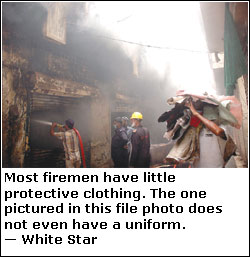
The highly hazardous conditions under which firemen work dictates certain specialised items of apparel, including boots with reinforced soles, specialised helmets and jackets made from heat-resistant materials.
A senior fire officer explained that a fireman’s helmet is specially designed and shaped in such a way that it protects not only his head and neck but also the spine in case of falling objects. The fire department, however, has equipped its men with industrial helmets and sweepers’ boots.
According to a senior officer, the city district government Karachi (CDGK) has issued inferior-quality jackets that are made of highly-inflammable parachute-material. Meanwhile, six sets of fire suits were given to each of the city’s fire stations. So that they can be displayed best, these suits are to be worn only by the fire-fighters manning the fire tender when it heads out of the station. The rest of the firemen fight the inferno in their ordinary uniform.
Firemen told Dawn that earlier, they used to get separate sets of summer and winter uniforms every year. In recent years, however, the winter uniform has been done away with under the pretext that cold weather is not experienced in Karachi – despite the manifest fact that the city is currently in the grip of a cold wave.
Even the summer uniforms have not been provided to the firemen for the past two years.
Despite this, however, a contractor who is supposed to provide the uniforms enjoys a conspicuous presence in the fire department. In fact, inside sources said, two years ago, the contractor prepared about 50 uniforms and took them around by turn to each of the city’s 21 fire stations. He would hand the uniforms over and his men would recover them from the firemen by paying out Rs800 per uniform. The same uniforms would then be taken round to the next fire station, recovered, etc.
As far as required items such as batches, buckles and belts are concerned, they are bought out of the firemen’s own pockets. “The department is not interested in these things,” they complained.
The lack of training and equipment
There is no concept of imparting training or holding refresher courses in the fire department, and almost all the personnel have learned their work on the job, in the line of duty.
When the district municipal corporations were disbanded in 2001, the surplus staff of Grade-1 was sent to the fire department. They were promised that they would be given proper fire fighting training and that they would be promoted to Grade-5. Despite the passage of many years, however, they are still in Grade-1 and taking part in fire-fighting operations without training or proper uniforms.
Meanwhile, fire stations suffer a crisis of equipment. On Monday, as Dawn conducted its inquiries, five fire stations were out of commission because their fire tenders had developed faults.
As a result, when a fire broke out in the Bhorapir area of Ranchore Lines, fire tenders were called from as far away as Manzoor Colony and Orangi town. A duty officer at the Central Fire Station confirmed that fire tenders were called in from Manzoor Colony to extinguish a fire that broke out at the Teeja Street flat of Mr Farooq. He added that by the time the fire tenders managed to reach the spot, the flames had been doused with fire extinguishers. The cause of the fire could not be immediately discerned and neither had the extent of damage been ascertained as yet, he said.
In terms of repairs required by fire tenders, sources informed Dawn that the city government recently paid a substantial sum to a private workshop for repairing fire tenders. “The money appears to have gone down the drain,” they remarked.
They also pointed out that hosepipes, a basic necessity for any fire fighting operation, are in poor repair. Many of them are punctured or fall short during an operation. As a result, fire tenders have to be called from other fire stations when, in fact, the strength of only one station is required.
There ten fire stations in the city with associated residential housing colonies for firemen and fire officers. Increasingly, however, firemen are being posted to stations other than where they live; for example, a man living in the Nazimabad fire station quarters is posted to the Landhi fire station or vice versa. As a result, crucial time is lost in commuting.
The fire department is critically short of technical equipment and manpower. The fire tenders have outlived their usefulness while there are collectively only ten station fire officers in the 21 fire stations across the city. Despite this shortage, however, a former chief fire officer (CFO) and a station fire officer recently opted for employment in PPL against lien obtained from the fire department. This growing trend, remarked a fire officer, shows the depth of the frustration within the department.






























