



 0
0

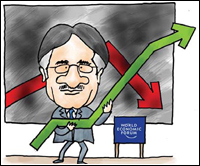 Quoting economic numbers or sweet talk at a global investor forum will not help. Pakistan needs to recast its image before it succeeds in attracting new investment or sustaining the investment already being made by the overseas companies.
The image of the country projected abroad over the last one year was not enviable. It was projected to be a country at war with itself, a nation whose judiciary was struggling for justice, and defence personnel hankering for security; a country where civil society was trying to protect its rights, industrial plants closing down for want of uninterrupted energy supply, and where ration cards had to be introduced to cope with food shortages and price hike. It was projected as a country where the writ of the government was weak and despite repeated reassurances people doubt that it would hold free and fair elections and on the announced date.
It was brave of Pakistani leaders to have gone out there and make an attempt to sell Pakistan as a possible destination of investment at this point in time, an influential diplomatic source said commenting on participation of Pakistan’s delegation in the World Economic Forum.
It was a useless expensive exercise that could have been avoided. If you start on the wrong foot, you will tumble. The credibility of a country for international investors cannot be higher than what it is for the local businessmen. All you need to do is to ask any local investor about his immediate investment plans and you will get the answer, said Dr Zubair Khan from Lahore who was finance minister during Farooq Laghari’s interim government.
“I am here to dispel misconceptions about Pakistan amongst international investment community”, President Pervez Musharraf was reported to have told business elite at Devos. If
local investors were shy and put important investment decisions on hold, it would be absurd to expect foreigners to enter, what the reputable business magazine, Economist called, the most dangerous place on planet, said a senior business leader from Islamabad. “We cannot afford to give up. We must participate in international forums. It was the right decision to participate, if nothing to show that we were around. The problem was with the team that represented the country. You need to be both smart and credible to earn investors confidence. Unfortunately our leaders fall short on both counts, said a senior executive working with a lending agency wishing anonymity.
Arthur Bhayan, the CEO of Competitive Support Fund was optimistic. “The delegation, I understand, must have tried to convince the prospective investors that fundamentals of the economy were strong with most companies doing very well, the market friendly policies would continue even after the next government assume charge and the elections would be held on specified time of Feb18”.
Davos was not a mere parade of those who have reached high enough to have made it to the meeting. It was a gathering of most shrewd men and women who cannot be fooled by pep talk, said another local businessman weary of the prolonged period of uncertainty.
An attempt was made to get official response on the issue but secretary finance was in Karachi and could not make himself available despite repeated requests. None of the other officers of economic ministries reached over telephone were aware of the agenda that the official delegation was supposed to be pursuing at the WEF.
Without the strength of institutions and people no government could deliver. Which investor would dare oblige such uprooted band of self- appointed people?, asked an annoyed analyst in Karachi who wished not to be named.
A senior official accompanying President Musharraf as a member of Pakistan delegation told Dawn on condition of anonymity that the delegation had to conduct business in what he termed hostile environment. “We did what we could have done in the current situation: reassure people that fair elections were just round the corner that will put an end to the phase of uncertainty”, he said from Davos.
The business and political elite of the world pondered on business strategy and investment options in wake of tumbling key capital markets and fragile state of world financial system at the World Economic Forum.
Chances are slim that Pakistani delegation could have charmed prospective investors or successfully calmed the nervous foreign financiers who have already invested here.
Every year around this time Davos, the scenic ski resort of Switzerland, plays host to the big and mighty of the world. These leaders converge there to strengthen old links and establish new contacts. This year, however, the negative world market news took some shine off the glitzy event. The tumbling key capital markets and fragile global financial system posed fresh questions over the prospects of global economy and reliability of strategies and options pursued so far.
Till the last year, the fault lines of global economic system were not as obvious and news of bumper corporate profits, strong economic growth and tame inflation set the tone that infused optimism in participants. But the current 38th World Economic Forum was held at a time when the global economy was grappling with massive slides in stock markets, fears of a US recession and the rising oil, food and other commodity prices.
The atmosphere, therefore, was not buoyant in Davos. What the World Bank senior delegate called the better-equipped developing countries to cushion the global market fluctuations and strong fundamentals in giant Asian economies, however, provided some solace to the stressed power brokers.
The Pakistani delegation was headed by no less than President Pervez Musharraf and comprised of star members of the economic team of the last government who were not shunted out in the caretaker set-up.
Those who travelled with the President included Dr Salman Shah, the caretaker finance minister, Dr Ashfaque Hasan Khan, the special secretary finance, Dr Shamshad Akhtar, Governor State Bank of Pakistan, Mr Riaz Mohammad Khan, foreign secretary, Mr Mushtaque A. Mullick, Secretary investment. Besides them, there were many more: security and supporting staff that included officers from several embassies in Europe and the US.
There was no one in the ministry of foreign affairs or ministry of finance willing to divulge the exact number of people who travelled as part of the delegation on public expanse or quantum of the money spent on the event.
One could only hope that by the same time next year, under an elected government, Pakistan would have a better deal to offer to the global investors community at WEF 2009.





























