



 0
0

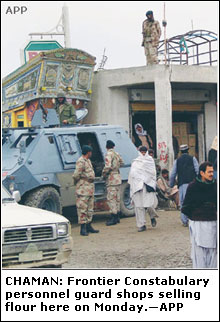 KARACHI, Jan 14: Is this a case of collapse of the civilian authority that contingents of Rangers and Frontier Constabulary are being deployed at main points of the wheat and flour supply system across the country – at godowns to mills and mills to the main distribution points?
‘No’ was the answer from a responsible officer involved in the wheat business management.
He termed the deployment of Rangers a purely “coercive administrative measure to counter powerful market manipulators because consumers cannot be left at the mercy of market wolves.”
He blamed media for portraying even small lapses of the government as ‘institutional collapse’.
“But why did it take almost eight months for the government to intervene in the market when the flour price has jumped three times, from Rs14 a kilogramme in May 2006 to Rs35 a kilogramme in the first week of January? Who are these market wolves and why were they given a free hand this season and in the previous seasons to fleece consumers”?
The official ignored the questions and said: “I assure you that consumers would be getting wheat flour at affordable prices in all parts of the country within a few days.”
He was frank enough to concede that the deployment of Rangers to ensure smooth supply of wheat and delivery of flour at Rs18 to Rs19 a kilogramme to the consumers was not a “market solution”.
“This is an exercise that will last till the elections on February 18,” a shopkeeper in Soldier Bazaar said.
He appeared to be convinced that the purpose of deploying Rangers and Constabulary is to ensure that voters got flour at Rs18 or Rs19 a kilogramme till the election day.
“Thereafter, it will for the government to address the issue and by that time wheat will start trickling in from fresh crop,” he said.
Bilal Sufi, a leader of flour millers in the country, believes that the deployment of Rangers and other administrative measures would not ensure smooth and uninterrupted supply of wheat and flour to consumers.
“It is the decision of government that matters,” he said.
He said that last year in the months of March-April when the government, in anticipation of a bumper wheat crop, went for early export, the Indian government was exploring the world market to place orders for 5 million tons of wheat.
India is now providing wheat to its citizens from its own stocks while we are facing all sorts of problems.
He recalled the warning he had given when the government decided to export wheat early in the season.
“We will export wheat at $200 plus a ton and import wheat from Russia and Ukraine at half the price in September-October” the then federal food secretary is reported to have said in response to Bilal Sufi’s warning.
“Wheat is now being offered at $550 and $550 a ton in the international market,” he said.
“No heads rolled when this decision cost the government a heavy amount in foreign exchange on import and on account of hefty subsidy on local trading and caused untold misery to the public, political worker of an opposition party remarked. Obviously, wheat and floor prices will be an election issue.
Raees Ashraf Tar Mohammad, leader of the Pakistan Grocers Association, recalls having warned in November of a massive price hike.
It is not only wheat and flour but all grains and edibles are showing an unprecedented price hike.
“More people have been pushed down the poverty line in these few weeks than in the previous decade,” he said.
He said that the falling exchange value of the rupee was making all essential items costlier.“Look at India where appreciation of currency is protecting consumers from import of inflation,” he said.
Over the past one year or so, the Indian rupee has appreciated from Rs43 a dollar to Rs38 a dollar.
He ridiculed exporters’ assertion that devaluation of Pakistani rupee would help exports to grow.
“Pakistan’s exports stagnated at 8 billion dollars when the dollar was worth Rs48 and when it touched the peak of Rs66 after nuclear explosions, he recalled.
In its recent quarterly report, the State Bank of Pakistan has declared that domestic economy is more prone to external shocks now than ever before. “Domestic prices will be more sensitive to the changes in international prices, despite domestic availability,” the report says.
It cites rice as an example Pakistan has sufficient quantity of exportable rice. However, following a rise in the international price the domestic prices have also increased.
Inquiries reveal that basmati is selling locally at Rs75 a kilo, Irri-6 at Rs40 a kg and second grade basmati at Rs60.
The SBP advice is to narrow down the difference between the farm-gate price and international price of agricultural products. Farmers should be given incentives.
But the problem is that neither the government nor any political party is ready to empower the small farmer by giving him access to bank credit, providing him farm inputs at market rates and developing the holding capacity so that a farmer can get the due price of his produce.




























