0
0

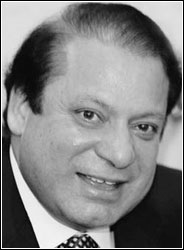 ISLAMABAD: Pakistan Muslim League chief Mohammad Nawaz Sharif speaks about the fundamental reforms initiated during his tenure to strengthen institutions. The following is the text of an interview with Mohammad Nawaz Sharif:
Question: The private sector is highly skeptical of political parties. How you intend to allay their fears that if voted to power, the PML-N government would weaken institutions by political interference?
Answer: They only have to recall that in both our tenures we introduced fundamental reforms to strengthen institutions, partly by privatisation and partly by reducing the discretionary role of public sector. For example, the system of import licencing and industrial permits was abolished. Banking reforms in 1997 gave autonomy to the central bank through five different laws. All the government directors were withdrawn from three nationalised commercial banks — NBP, UBL and HBL. Their heads at that time, namely Mohmmadmian Soomro, Zubair Soomro and Shaukat Tareen, are still around. Anyone can ask them if I or any other member of my cabinet ever asked them to give any loan on political grounds.
Q: What would you do to change the system of cronyism and to move towards a merit-based transparent government?
A: In both our tenures, we expanded the policy for merit-based recruitment. The responsibility of recruitment in BPS-11 to 15 was transferred to the Federal Public Service Commission. A Banking Services Commission was also established in 1991 to introduce merit-based recruitment through annual competitive examination in the banking sector.
Q: How you intend to generate funds for higher social sector spending?
A: Despite sanctions imposed on Pakistan in 1990, we had doubled the social sector spending in 1992 through Social Action Programme (SAP) by cutting non-essential expenditure. In fact, expenditure on education and health in the early and mid-90s was higher than it is today, in spite of such a large increase in the fiscal space after 9/11.
Q: How would you evolve a more inclusive development process?
A: In our manifesto, we have presented a comprehensive package of pro-poor policies, institutions and programmes to reduce poverty. A key element of this package will be stabilising food prices. Another will be to expand opportunities for employment. We have also promised a minimum wage of Rs6,000 for government employees.
Q: Would the thrust of economic policy of privatisation, deregulation and liberalisation would continue, if your party is voted to power?
A: In fact, the policy of privatisation, deregulation and liberalisation was initiated on a substantial scale by my government in its first tenure from 1990-93 through a comprehensive process of reforms. The PPP government followed to continue the same policy framework, as well as the Musharraf government in eight years.
Q: Will your manifesto include quantifiable targets in social sector over some timeframe. For example: in health sector, PPP could have committed to increase the budget from under one to two or three per cent. Will the millennium development goals figure in your manifesto. If voted to power, will the PML-N strive to achieve these goals?
A: Our manifesto promises 100 per cent enrollment in middle school education and matriculation level by 2012 and 2015, respectively, and 80 per cent in the higher education by 2020. In health sector, we have promised coverage against hepatitis to two-thirds of the population and vaccination against many other diseases up to 75 per cent. The main MDGs, including poverty, education and health, are adequately covered in our manifesto.
Q: The greatest fear of the business community is that the next political government will again be unstable as it would in their view be a coalition government paralised by infighting of partners?
A: If voters want a stable government, they should vote overwhelmingly for the party that stands for independent judiciary, rule of law, stable democracy and a pro-poor development strategy.
Q: What would you do to address the issue of economic deprivation leading to political alienation in Balochistan, Northern Areas and the interior of Sindh?
Q: We have promised a much higher level of provincial autonomy to Balochistan and other provinces in our manifesto, along with larger financial resources through the National Finance Commission (NFC) every five years. In 1991, a unanimous NFC award had increased financial allocation to Balochistan three-fold in a single year. In the large run, the sense of deprivation from the provinces can be addressed only through a genuine and participatory democratic process.