



 0
0

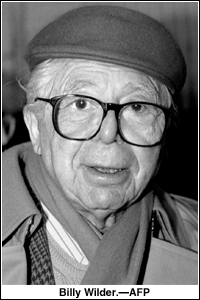 LOS ANGELES, March 29: Director Billy Wilder, who went from being a refugee from Nazism unable to speak a word of English to the creator of such classic American films as “Some Like it Hot” and “Sunset Boulevard”, has died at age 95, friends said on Thursday.
Producer George Schlatter said Wilder, who had been in failing health in recent years, died “peacefully” on Wednesday.
Wilder was the first filmmaker to win three Academy Awards in a year (for “The Apartment” in 1960) and was a master storyteller specializing in the dark side of American life with a cynicism and black humour few movie-makers have ever matched.
“He had an utterly unique sensibility,” Time Magazine film critic Richard Schickel said, adding that “‘Sunset Boulevard’ may be the greatest commentary on Hollywood life ever made. Every scene is bizarre.”
Although he spoke with a heavy accent and only learned English after arriving in Hollywood penniless in the 1930s, Wilder was a master of dialogue. He called his English “a mixture between Arnold Schwarzenegger and Archbishop Tutu”.
He created some of Hollywood’s most famous dramas including “Double Indemnity”, “The Lost Weekend”, “Sunset Boulevard” and “Stalag 17” — as well as some of its funniest farces: “Some Like It Hot” and “The Fortune Cookie”.
He was also first to pair Jack Lemmon and Walter Matthau, creating one of the screen’s most beloved comic teams.
His dialogue is considered among the sharpest ever honed for the screen, including the exchange in “Sunset Boulevard” when faded star Norma Desmond is told that she used to be big and replies: “I am big. It’s the pictures that got small.” In his last years, Wilder often complained he could not get work.
Wilder received 21 Academy Award nominations and won six Oscars. Three of them — best director, best screenplay and best picture — were for “The Apartment” in 1960, making him the first filmmaker to win three Oscars in a year.
Wilder’s films showed a suspicion of mankind’s motives that some traced to his bohemian youth and the loss of family members, including his mother, in Nazi death camps. He had a wicked sense of humor that turned even his dramas into black comedies. His film “Ace in the Hole,” starring Kirk Douglas, is often looked upon as one of the darkest films ever made in Hollywood — a cynical tale of a journalist turning the search for a trapped man into a circus sideshow.
Wilder summed up his filmmaking philosophy in Ten Commandments: “The first nine are, thou shalt not bore. The tenth is, thou shalt have the right of final cut.”
‘GET PART OF THE GROSS’: He also said: “If you can do something lasting and get 10 percent of the gross, what’s wrong with that?”
Wilder had a gruff exterior. Beneath it, friends said, was a gruff interior. In his biography of Wilder, ‘On Sunset Boulevard,” Ed Sikov noted that he was famed for his feuds as well as his friendships. Among those he battled with were Peter Sellers, Humphrey Bogart, Bing Crosby and Marilyn Monroe with whom he had titanic rows during filming of “Some Like It Hot.”
When the shooting was finally finished, Sikov said Wilder confided to reporters that “I am able to look at my wife again and not want to hit her because she is a woman”. Monroe called Wilder’s wife Audrey and told her: “Tell Billy to go —— himself and my best to you Audrey.”
Wilder once described Monroe having “breasts like granite and a mind like Swiss cheese” although he conceded, “Better Marilyn late than most of the others on time.”
Wilder also had close friendships with actors, including William Holden, Audrey Hepburn and Lemmon and Matthau. Holden once called him “a man with a mind full of razor blades.”
Wilder’s screenplays sparkled with such lines as the one read by Robert Benchley in “The Major and the Minor”: “Why don’t you get out of that wet coat and into a dry martini?” He once ordered a cameraman: “Keep it out of focus. I want to win the foreign-picture award.”
Wilder was born Samuel Wilder on June 22, 1906, in the Polish town of Sucha, then part of the Austro-Hungarian Empire. His mother nicknamed him Billy after western hero Buffalo Bill.—Reuters




























