



 0
0

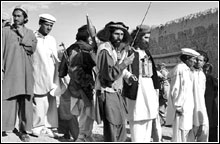 THE rise in militancy in restive tribal areas and its spill over to the country’s settled parts is impacting the overall economic activities and impeding fresh investment in the NWFP and Fata.
The prevailing unrest in the tribal areas mainly in the North and the South Waziristan Agencies, which simultaneously share boundaries with Afghanistan and the three main southern districts of NWFP — Dera Ismail Khan, Bannu and Tank — began in early 2004.
According to reports, all major commercial banks and post offices have been closed down in Miramshah and Mirali, sub-divisions of the North Waziristan Agency some few months back after being attacked and robbed by militants.
“A local living in Miramshah, if he wants to make any transaction or post a letter, has to travel to Bannu, where the banks and post offices have been shifted,” said a local from the North Waziristan Agency.
Officials of the Pakistan Post said that security forces refuse to carry parcels to Mirali and Miramshah for security reasons. It had also become difficult for the government agencies to carry out mega development projects in the area.
For instance, it is feared that the Gomal Zam Dam, a multi-million dollar project, could be the first major prey of the ongoing unrest in the two Waziristan agencies. Work on the project was suspended in 2004, following the kidnapping of two Chinese engineers reportedly by the tribal militants. One of the engineers died in a rescue mission by military commandoes in the South Waziristan.
The dam, having a height of 437 feet, is located on the Gomal River, which is one of the significant tributaries of the Indus River. The dam was planned to irrigate about 163,000 acres. Being a roller compacted concrete dam, it will have a gross storage of 1.14 MAF. It will also produce 17.4 MW of electricity when completed.
M/s CWHEC-HPE, a joint venture of two Chinese firms, had been given the contract of the dam in August 2002 which was supposed to be completed by June 2006. But, the authorities are still unable to commence work on the project mainly because of security reasons.
Fragile security situation is also hampering government efforts to bring foreign investment to Fata in the field of minerals, gas and oil exploration. Huge minerals, gas and oil reserves are believed to be located in the 600km-long strip bordering Afghanistan.
“Fata has vast metal, mineral, oil and gas reserves, but neither local investors nor foreign entrepreneurs are willing to invest in this region because of insecurity,” said an official at the Mineral Directorate of Fata Secretariat.
According to him, investors from Australia, Sweden and other countries were interested in investing in the minerals sector, particularly in the exploration of copper, but law and order situation is discouraging them.
The federal government had recently awarded a licence to a multinational company for exploration of oil and gas in the North Waziristan Agency and its adjacent Bannu Frontier Region.
South Waziristan is said to have vast prospects for oil and gas deposits and the area has been leased out to the Tullo Company for exploration of these reserves. Geologists have already detected 7,000 tons of marble, eight million tons of coal, 537,000 million tons of silica sand, 5,000 million tons of manganese, 3.6 million tons of soapstone, 20,000 million tons of gypsum and massive reserves of limestone in different areas of Fata.
The federal government had set up the Fata Development Authority to explore the mineral resource. According to the officials, it could do nothing because of the law and order situation there. In the Waziristan area, local authorities are even not able to implement the community development schemes.
Establishment of Reconstruction Opportunities Zones (ROZs) in collaboration with the United States of America in the tribal belt is another project of great importance, which is lingering on for the last one-and-half years just because of security reasons.
President Bush, during his visit to Pakistan in 2006, had announced the setting up of ROZs in the tribal areas to improve the lot of the people. He had announced that goods produced in these zones would get duty-free access to the US markets.
However, a Peshawar-based US diplomat said that US administration’s main concern was the fragile security situation in the tribal area that may delay the execution of the project.
Growing militancy has also affected oil and gas exploration activities in Kohat and Karak districts. Exploration work in the southern districts of the province had proved to be an important source of income for the cash-strapped NWFP government which received royalty from the federal government.
Currently there are three oil and gas fields in the province, located at Chanda (Shakardara-Kohat), Manzalai (Karak) and Makori (Karak). Regular production from Chanda fields started on July 17, 2004, from Manzalai field on Jan 31 2005 and from Makori in Jan 2006.
The Petroleum ministry had awarded licences for exploration of oil and gas at 22 potential sites in the southern districts of NWFP, where huge reserves are believed to be located.
Most of the exploration operations were carried out by foreign companies, mainly Chinese, who have left the area some few months back after target killing of their fellow countrymen in Peshawar by unknown assailants.
A spokesman for the Oil and Gas Development Company (OGDCL) confirmed that the Chinese engineers working on exploration sites in Kohat district had left the area for security reasons. Pakistani engineers were working on the same projects. However, the absence of Chinese experts was causing delay in the work.
Businessmen in Peshawar are also concerned about the worsening law and order situation in the province particularly the tension in Swat.
Liaqat Ahmad Khan, President of the Sarhad Chamber of Commerce and Industry, says: “Peace is a prerequisite for development and industrialisation, however, the prevailing situation in the NWFP in which suicide bombing has become a routine affair, is neither conducive to development nor economic activities. This insecurity has compelled the NWFP businessmen to shift their capital to Punjab.”
In his views, when the domestic investors were reluctant to do business here, how could it be expected that foreign investor would come and invest in the province in projects such as hydropower generation, minerals and tourism.
Zia-ul-Haq Sarhadi, executive member of the All Pakistan Commercial Exporters’ Association (APCEA) shared similar views, when he was asked about the success of forthcoming International Gems’ Show, a regular event held in Peshawar every year.
Like previous years, the show will be held by the end of this month in Peshawar, where, according to the organisers, delegates from 40 different countries are expected.
Mr Sarhadi, however, did not agree. He says: “Most of the European countries have advised their citizens not to travel to Pakistan for security reasons and the state of emergency which has further aggravated the situation. In such circumstances, the forthcoming show will not be a success and will be wastage of resources,” he felt.




























