



 0
0

 KARACHI, Nov 6: While lawyers at the City Courts and the Sindh High Court boycotted proceedings on Tuesday, the second consecutive day of their campaign against emergency rule, not a single major protest was staged indicating that the reign of terror unleashed by the government against the legal fraternity is not entirely unsuccessful.
Dozens of lawyers gathered inside the City Courts, with many preferring not to dress in their conventional black coats and white trousers, and did not appear before any bench for the proceedings of cases.
A general body meeting of the Karachi Bar Association (KBA) later adopted a resolution reiterating its stance against the emergency rule under the Provisional Constitutional Order (PCO) imposed by President General Pervez Musharraf acting as chief of the army staff last week. The resolution also sought action from within the army against its chief.
“That the general body appeals to the United Nations, the international community and to the corps commanders to exercise their influence for the removal of Gen Pervez Musharraf from the post of president as well as from the post of chief of the army staff, so that the country could be saved,” says the KBA resolution.
The KBA resolution also demands the immediate release of the lawyers arrested across Pakistan on Monday. However, a couple of hours after the resolution was passed, some 150 city lawyers, who had been arrested while protesting against emergency rule on Monday under the Maintenance of Public Order (MPO) Ordinance, were sent to jail custody.
“There were some 150 persons — mostly lawyers — who were sent to jail custody from different police stations,” said an official wishing not to be named. “They have all been arrested under the MPO, which states a 90-day detention of the person.”
A senior member of the KBA admitted that fear had gripped his colleagues who faced serious threats against their professional careers and also their lives, as the city had witnessed the brutal killings of several lawyers in September 2007.
“Yesterday’s police action has further increased such feelings. But we hope to continue the struggle against emergency rule in any capacity available,” he added.
But the authorities seemed firm not to allow any flouting of the government’s orders banning demonstrations and public gatherings across the province, adding that action would be unavoidable if the orders were challenged.
“The city remained peaceful on Tuesday and not a single violation of the law was witnessed,” said Capital City Police Officer Azhar Ali Farooqi. “But if the law is violated, the police will move regardless of the place, premises or venue of such violation,” he warned.
Meanwhile, Judicial Magistrate, South, Zeeshan Akhter remanded nationalist leader Mir Hasil Khan Bizenjo along with four other political and labour leaders. Mr Bizenjo was arrested on Monday while protesting against emergency rule at the Karachi Press Club.
Yousuf Masti Khan, Liaquat Sahi, Ayub Qureshi and Farid Awan were among others who were given in police remand till Nov 8. All the five persons were booked under Sections 124-A, 147, 148 and 149 by the Artillery Maidan police.
Sources in the police said more than 100 activists of different opposition parties, including the Jamaat-i-Islami, Jeay Sindh Qaumi Mahaz and Tehreek-i-Insaaf, were arrested in midnight raids across the city.
Meanwhile, the Frere police lodged an FIR (264/2007) against five journalists arrested while protesting at the Karachi Press Club against the government’s attempt to stop the publication of an Urdu daily’s supplement.
The authorities levelled incredibly harsh and unjustified charges against the working journalists and booked them under sections as severe as police encounter and attempt to murder.
The police filed charges under Sections 148, 147, 353, 324, 125 and 395 against all the five journalists -- Mohammad Mohsin, Tariq Fazl-ur-Rahman, Asghar Shah, Shariq Ahmed and Nazeer Khan. Later, the police released all the five journalists on personal surety.
SHC’s proceedings
Lawyers continued their boycott of court proceedings at the Sindh High Court while routine judicial work was executed by judges in their chambers with the help of advocates compelled by their clients to argue their cases. Justice Munib Ahmad Khan also conducted open court proceedings in a few cases.
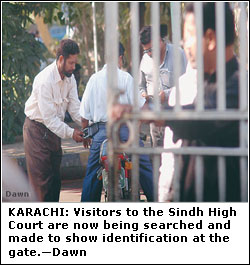
Entry to the court premises was restricted and media-persons were particularly denied access to keep them away from the lawyers holding protest meetings in the bar room and to facilitate the official claim that the court functioned normally.
Former Sindh High Court Bar Association presidents Akhtar Hussain and Abdul Hafeez Lakho addressed an SHCBA general body meeting. They said protests against the imposition of emergency would continue. There would be a complete strike on Wednesday also. They said about 2,500 lawyers had been detained across the country through orders issued under the MPO Ordinance.
However, no petition against their detention would be filed under Article 199 in any high court as the judges have taken oath under a PCO curtailing civil liberties and fundamental rights.
They regretted the transfer of the Sukkur district and sessions judge who, they said, had asked a judicial magistrate to inspect a police station for the recovery of a detainee. The SHO of the police station refused entry to the magistrate and complained to his officers against ‘judicial interference.’ The district and sessions judge who allowed the habeas corpus petition was transferred by the high court, they alleged.
Meanwhile, Sindh Bar Council member Noor Naz Agha, who was recently elected President of the Pakistan Women Lawyers’ Association, has been placed under house arrest for 30 days under the MPO.
DAG’s denial
Deputy Attorney-General Rizwan Ahmed Siddiqui, meanwhile, denied on Tuesday that he was pushed around or roughed up either by the police or by the lawyers. He said no such incident took place and he not only entered the high court building and his office therein without any hassle, but also helped some lawyers and litigants enter the court premises.






























