0
0

 KARACHI, Oct 22: A seven-member bench of the Sindh High Court asked the federal interior secretary on Monday to submit a detailed affidavit on security arrangements required by rules to be made and actually made for Chief Justice Iftikhar Mohammad Chaudhry’s visit to Karachi on May 12.
The bench, which consists of Justice Sarmad Jalal Osmany, Justice Anwar Zaheer Jamali, Justice Mushir Alam, Justice Azizullah M. Memon, Justice Khilji Arif Hussain, Justice Maqbool Baqar and Justice Ali Sain Dino Metlo, is conducting an inquiry into the May 12 incidents, with special reference to the blockade of the high court building.
A sizable number of Muttahida Qaumi Movement workers, who have filed affidavits in respect of the incidents, gathered on Shahrah-i-Iraq, the main road leading to the SHC building, but were not allowed to go beyond the passport office where barricades were placed by police. The other two approaches to the building were also barricaded. Entry to the main building was strictly by passes for non-lawyers. Attendance in the courtroom where proceedings were held was thin. The hearing was adjourned to November 5. A contempt application moved by the Karachi Bar Association against Chief Minister Dr Arbab Ghulam Rahim would also come up that day.
Petitioner Iqbal Kazmi, who had impleaded MQM leader Altaf Hussain as a respondent, meanwhile, sought to withdraw his petition. He said he had moved an application for withdrawal.
Appearing for the chief secretary (since transferred), the home secretary, the then provincial police officer and the capital city police officer, Advocate Raja Qureshi argued that the proceedings were initially commenced in exercise of suo motu power, which was not available to the high court under the Constitution. The bench pointed out that the SHC registrar’s report, which prompted the inquiry, has since been converted into a constitutional petition under Article 199.
The lawyer said the proceedings were not maintainable even under Article 199 as it involved factual controversies which could not be resolved without recording evidence. He cited Supreme Court judgments declaring that evidence could not be recorded in exercise of writ jurisdiction.
Advocate Qureshi thanked the bench for holding the inquiry to prevent recurrence of May 12 mayhem, which claimed 50 precious lives. But the bench observed that lapses and omissions did not occur in the abstract and certain officials must have been responsible for them. The lawyer pointed out that Karachi has a population of about 16 million and a road network of 9,000 kilometres of roads. The sheer size of the city and the paucity of human and material resources available for the purpose make law and order and crime control an uphill task.
Only those involved in the security and protection of VVIPs know how difficult it was to provide security, particularly on an unspecified route. In fact, VVIPs moved under police escort and sometimes their route had to be changed by security agencies for the sake of protection or to avoid an untoward occurrence.
The lawyer again recalled that the chief justice was requested to postpone his visit by the home department. He also alluded to President Musharraf’s advice to PPP Chairperson Benazir Bhutto, prompting the bench to ask him whether the casualty toll ‘goes up with the status of the source of advice or warning’.
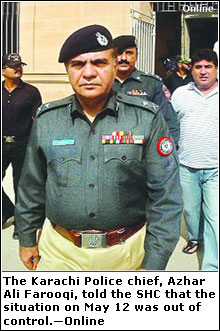
CCPO Azhar Ali Farooqui appeared before the bench at this stage and submitted that the situation on May 12 was out of control and he was helpless. He denied that the police force was unarmed or disarmed. Seven hundred sub-machine guns and 3,000 teargas shells were issued to the contingents deployed on the streets. But, as per standard procedure and practice, firearms and gas shells are to be sparingly used to disperse crowds as use of force may result in greater loss of lives. Shots were fired and gas shells exploded on May 12, but only to prevent greater mischief. No arrest was made on May 12, though a number of people were arrested following registration of 53 first information reports about the violent incidents.
Deputy Attorney-General Rizwan Siddiqui submitted that the federal government had no role in the security arrangements made for May 12 as they were a provincial matter. The bench wondered how the federal government could remain detached from the security of the chief justice of Pakistan. It asked the DAG to ascertain the rules regarding the protocol and security of the CJP and place them before the court.
The DAG said that as submitted by the federal interior secretary in his comments, the Rangers posted in Karachi, according to a 1995 notification, have been placed at the disposal of the provincial government for use as a back-up force. The bench observed that the federal government could have taken direct control of the Rangers or even deployed the military police. It was strange that there were no federal government instructions to any agency on the subject. The federal government, the bench observed, is duty bound to provide security to the CJP.
In reply to a court query, the DAG said the CJP’s visit to or his security in Karachi never came up for discussion before the federal cabinet. The minutes of a federal cabinet meeting held before May 12, however, did refer to a public meeting to be addressed by President Musharraf in Islamabad and a rally to be taken out by a coalition partner in Karachi. The DAG said the CJP visited Lahore and addressed roadside gatherings on way to the city but the federal government never figured in the arrangements. The provincial government of Punjab was exclusively responsible for all the arrangements, he added. The bench directed him to ask the federal interior secretary to submit a more detailed statement on oath with respect to the federal government role in the CJP’s security by the next date.