0
0

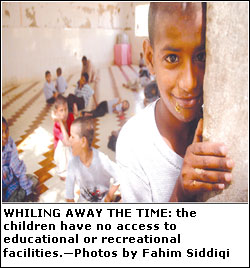 KARACHI, Oct 13: Of his life in the 65-acre Edhi Village for homeless boys and men, eight-year-old Haider Ali says, “Nobody comes to meet me; I am a gumshuda. I used to cry a lot when I first came here but I now have many friends and play cricket with them all the time.”
His comments are indicative of the inadequacies of the home which, while being of great significance given the government’s total disregard for the homeless and the abandoned, meets merely the basic requirements of food, shelter and clothing.
Located 56 miles beyond Karachi’s city limits on the Super Highway, the Edhi Village houses a hundred boys aged between eight and 18, 700 psychiatric patients and 227 senior citizens who were abandoned by their families for various reasons. However, the centre has scant medical services, provides no vocational or educational training and inadequate recreational facilities. The reason appears to lie in the absence of state support, the lack of resources and a citizenry uninterested in the fate of the people who fall between society’s cracks.
In Bacha Ward 2, where Haider lives, the children share not only their meals but also their past and present. What they are fast losing is their future and their potential to be valuable members of society.
Abandoned by society
 “Most of these children were either abandoned or their families have been reported untraceable,” said Dr Kamal Usmani, the full-time caretaker at the village. “Some of them had become addicted to sniffing glue before they were picked up by the police and dumped here. Others were withdrawn from the nearby child home school because teachers complained about their rowdiness, while some can’t be sent to the school because they are too old. None of them learn anything — they refuse to.” However, he added, the older youths would probably be sent on to the Sohrab Goth Edhi Home in order to receive some vocational training.
The children spend the entire day either sitting on the clean tiled floor of the four-room premises or playing cricket in the same area. Twice a day, they are taken out on an hour-long break to a ground, a restricted area, and then locked up in the ward again.
“Some of them have attempted to escape,” Dr Kamal told Dawn, “so we have to maintain security.” Asked why youths with a history of drug addiction were kept in the same ward as the children, he pointed out that these young men were no longer addicts and therefore posed no danger. However, he conceded that living conditions could do with improvement.
The village operates without electricity and telephone though it has its own generators that starts working late in the evening. Opposite the boys’ ward is the section housing about 60 mentally-challenged youths. While a consultant visits them on complaint and they are administered prescribed medicines to keep them manageable, no measures are taken to improve their condition or help them become independent in their daily routine.
There is also an additional area reserved for 26 children with severe mental and physical disabilities. The Edhi Village is able to meet merely their survival needs and the children lie on the floor all day before being taken to the hall in the evenings. They are looked after by those who suffer only mild disabilities.
‘No place to go’
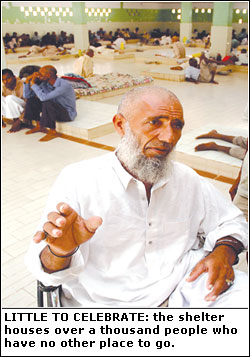
There are in addition a number of old and infirm inmates, some of whom are TB patients. Among the elderly are quite a few accident victims who arrived from government hospitals after being declared incurable. “I used to work as a labourer until I had an accident that left me handicapped for life. I have no place to go since most of my family died in the earthquake in Swat,” said 70-year-old Sher Khan who whiles away the time doing menial chores and resting in a large hall with others in his predicament. “The men in better physical and mental conditions help the weaker ones along, and so life carries on.”
According to Dr Kamal, there are about 80 admissions in a week to the senior citizens’ hall while between 14 and 16 people die every month, mostly because of old age. “We make daily rounds and are informed in case of an emergency,” said Dr Kamal. “Every person goes through a medical examination at the time of admission.”
Asked about the lack of individualised care at this village, secretary to Abdus Sattar Edhi and in charge of the information bureau, Anwar Kazmi, explained that the charity-funded organisation is desperate to hire educated and specialised staff. “We have advertised many times but never got a positive response,” he said. “We realise the shortcomings but there are financial constraints that cannot be ignored. That is one of the reasons this village was established outside the city. Furthermore, this is not a rehabilitation centre b but a shelter. We are currently running 17 such shelters all over the country housing about 8,000 people. Youths are provided vocational training at other centres and it was with their help that we built makeshift houses for earthquake victims,” he pointed out. “All of society is responsible for the people who live here and collaborative efforts alone can ensure a better future for them.”