0
0

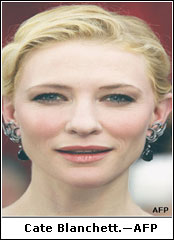 LOS ANGELES: She might be firmly established as a member of Hollywood royalty, but Cate Blanchett admits she was nervous about returning to the throne for her latest screen role.
Nearly 10 years after her portrayal of Queen Elizabeth I helped propel her to international stardom, the 38-year-old Australian actress is reprising her role as the British monarch, in “Elizabeth: The Golden Age”, which opens in the United States on Oct 12.
It is the latest stop on a career that has seen Blanchett emerge as one the most versatile actresses of her generation, whether it’s a daring portrayal of Bob Dylan in a biopic or the latest Indiana Jones blockbuster.
Blanchett’s performance in Indian director Shekhar Kapur’s ‘Elizabeth’ opened the door to superstardom, earning her the first of four Academy Award nominations and landing her a Golden Globe statuette.
Yet even though Blanchett might have been born to play Elizabeth, the actress says she was nervous about re-teaming with Kapur and fellow Australian Geoffrey Rush for the sequel.
“It was very daunting, and I was a bit nervous about returning to a character that had allowed me to walk through a door into an international film career,” Blanchett told reporters in Beverly Hills.
“You don’t ever want to feel like you’re going backwards. But once I’ve perrceived that I could progress forwards by playing it then I could proceed with it.” Whereas the first film focused on Elizabeth’s ascent to the throne, “The Golden Age” uses the conflict with Spain as its backdrop and imagines a love triangle involving the queen and British explorer Sir Walter Raleigh.
Blanchett says the plotlines of the story persuaded her to revisit the character.
“I found that the notion of the love triangle, the structure of the narrative was quite different,” she said.
“I always said that if I did another one, Elizabeth shouldn’t be the central character and because it’s an unabashedly romantic film, I think was quite different. So it didn’t feel like treading the same ground.” While the stories of the two movies are distinct, they remain similar in one respect: both take numerous liberties with history. There is for example, no record of a romantic element to Elizabeth and Raleigh’s relationship.
Blanchett however remains unapologetic for the use of artistic license in “The Golden Age”.
“In the end when you only have a couple of hours to tell an incredibly dense period of history, by a process of selection you’re automatically telescoping the events,” she says. “It’s never going to be like reading the letters and the court documents, or reading a biography of Elizabeth. It’s not the same experience, and going to see a film shouldn’t be.
“You’re being told a fable, and a fable through the eyes of that director. So hopefully the film has a contemporary quality.
“Like all good stories you’re able to connect to the current collective unconscious, what we’re all thinking about, about what it means to be female now and what it meant to be female then.” And speculating on the desires that may have driven Elizabeth is half of the fun, she adds.
“There were a lot of male courtiers that Elizabeth had strong connections with, and I think she was fascinated by the freedom that was afforded to, not only an adventurer like Raleigh, but men who were able to travel. She never left the shores of England,” she said.
While Blanchett’s portrayal of Elizabeth has become the gold standard for all future portrayals, the actress believes Hollywood’s fascination with the monarch will endure.—AFP