



 0
0

 Dr Ali Muhammad Khushk & Bhugro Mal
OIL palm is an important plant for obtaining edible oil. It is a tropical plant which grows in warm climates at altitudes of less than 1,600 feet above sea level.
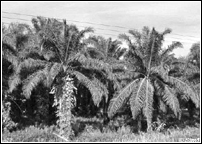
It is a perennial plant with a year-round canopy intercepting solar radiation. The tree grows up to 50 feet in height with large primate leaves. Oil palm is normally monoecious i.e., it has both male and female flowers on the same tree. It produces thousands of fruits in bunches weighing between 10 and 40 kilogrammes. The oil is derived from the fruit. A hundred kilogramme of fruit produce around 20kg oil.
Each fruit is almost spherical, oval or elongated in shape. Generally the fruit is dark purple, black before it ripens and orange-red when ripe. After soybean, palm oil is the second major oil produced in the world. From its home in West Africa, the oil palm has spread throughout the tropics and is now grown in over 16 countries. However, the major centre of production is in Southeast Asia with Malaysia and Indonesia together accounting for around 83 per cent of the world palm oil production.
A single hectare of oil palm may yield 5,000kg of crude oil, or nearly 6,000 liters of crude, making the crop remarkably profitable. An average yield of oil palm in major producing countries is about 3-4 tones of oil/ha/year. By contrast, the yields of most competing oil crops are typically less than one tone/ha/year. This means that productivity of oil palm is at least 3-8 times more than most oilseed crops. Thus, only seven million hectares of oil palm are required to supply 20 per cent of the world demand for oil and fats (1.09 billion tones), compared to the 80 million hectares of oilseeds needed to supply another 24 per cent of this demand.
Of the total produce of the world, only 10 per cent accounts for industrial uses. Palm oil is rich in carotene responsible for its red colour, and a rich source of vitamin ‘A’ and ‘E’ In addition palm oil is an excellent source of toco-trienol, a powerful anti-carcenogenic substance which is helpful against thrombosis.
Recently, it has been found that oil palm is a rich source of phenolic anti-oxidants which is good for health. Palm oil intake raises levels of the high-density lipoprotein (HDL, ‘good’ cholesterol) at the expense of the low-density lipoprotein (LDL, ‘bad’ cholesterol).
Palm oil (and its products) has good resistance to oxidation and heat at prolonged elevated temperatures; hence, making it an ideal ingredient in frying oil blends. Other parts of the tree may be used for industrial purposes such as leaf fibres and empty fruit bunches are used in making chipboard and plywood and the trunks of old palm trees can be used in making furniture. Palm oil is used in soaps, candles, detergents, lubricants, fuel, caked residue, cosmetics, and other personal-care products.
The plant is cultivated on various types of soils, with growth supported by better drainage and water content of the soil. The plant needs a well-drained sandy or clayey soil for better yield. The propagation is done by its seeds after providing proper treatment. The tree bears fruits within two-and a half years after plantation. Various tools are used to harvest the plant such as chisel or hooked knives attached to long poles and some times, by climbing on tree directly. The fruits are obtained from the tree till it gets around 30 feet high.
Pakistan is one of the largest consumers of palm oil besides China, India, Japan, Europe and the Middle East. An estimate of the per capita consumption of palm oil in the world is nine pounds per year with the total consumption figure of around 33 million tons. China is the maximum palm oil consuming country.
Pakistan’s ‘edible’ oil requirements have increased from 0.3 million tones to 1.95 million tones. The per capita consumption of edible oil is around 14-15kg as against an average of 8-9 kgs for developing countries. But yet production of edible oils has remained inadequate and fluctuating. So the requirements are met by supplementing local production with imports. Of the total requirements, 29.15 per cent is met from local production and the remaining 70.85 per cent through imports. Edible oil imports are a drain on national exchequer which has increased from Rs7228.6 million in 1987-88 to Rs 44975 million in 2004-05.
Cultivation of palm in the country can beautify the coastal areas and minimise environmental pollution reducing considerably the imports of edible oil bill.
Oil palm possesses great potential for plantation in coastal areas of Sindh and Balochistan where irrigation facilities are available. In Sindh areas of Karachi Thatta, Badin, Hyderabad (Tando Muhammad Khan), Mirpurkhas, and Sanghar (Tando Adam) are suitable for cultivation of oil palm whereas Vinder and O’Mara in Balochistan are also potential areas.
Income of farmers in the above areas of Sindh ranges from Rs10,000 to Rs32,000 per acre per year through cultivation of sugarcane, rice, cotton, banana, onion etc. Whereas these areas of Balochistan are the poorest. Farmers grow maize, millet, moong, mash and fodder. Income level of farmers in these areas is very low. From one acre oil palm plantation, the growers can earn an income of about Rs40,000 to Rs50,000 per year. Additional income can be generated by intercropping various crops in the oil palm fields.
Introduction of palm oil crop in both the regions will result in bringing a positive change in the socio-economic status of the population and provide employment opportunities besides triggering development in the area. The Oil Palm Development Pilot Project (ODPP) was approved at a cost of Rs61.655 million for implementation in the province of Sindh in the areas of Thatta, Badin, Hyderabad, Mirpurkhas and Tando Adam of Sanghar districts and in Balochistan areas of Uthal, Hub, Pasni, Gawadar, Jewani and Ormara.
The actual oil palm acreage which has successfully been achieved under this project is 1,009 acres. Around 48,000 seedlings were imported from Malaysia in October 2002. Oil palm plantation on 30 acres at Vinder farm in Balochistan is being looked after with satisfactory results with banana inter-cropping. Farmers are getting appropriate income by intercropping sugarcane, wheat, sunflower within the oil palm plantation.
Although, sugarcane and banana are exhaustive crops but they help in the growth of oil palm by creating micro-environment and increasing humidity. The Parc has also successfully introduced oil palm at the Coastal Agricultural Research Station, Karachi. Both, the plant growth and nut yield was obtained from 70 plants. At Hub and Pasni about 2,500 plants of hybrid oil palm were planted by Agriculture Department, Balochistan, and are being maintained with promising results.
A complete package of production technology is essential for the promotion of oil palm in the country. Research work is therefore, needed for the purpose. There is a need for training of the manpower involved in oil palm cultivation and development. Private sector should also be involved in the oil palm promotion and installation oil extraction mill. Highly saline areas need to be avoided to grow oil palm. Proper plant, water and soil management is also needed for the success of the plantation.




























