0
0

ISLAMABAD, March 18: The Chief Executive Secretariat on Monday decided to review the controversial Greater Thal Canal Project, increase water supply to Sindh till March 31 to facilitate sowing of Kharif crops, and approach the Supreme Court over the interpretation of Clause 14-B of the Water Accord, 1991.
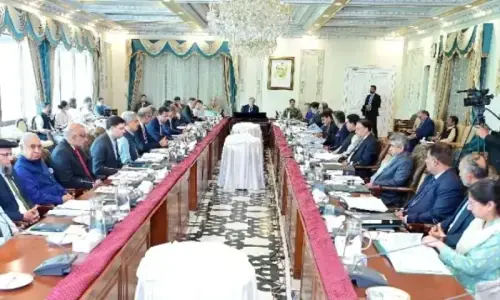
The decisions were taken at a meeting held by the Principal Secretary to the Chief Executive, Tariq Aziz, with irrigation secretaries of Punjab and Sindh, Tariq Majeed and Mir Mohammad Parhiyar, respectively, a highly placed source told Dawn.
As a consequence of the decisions, the source said, the construction of Thal Flood Canal, which had been started by Wapda even before Ecnec could have accorded approval to it, would be stopped.
The meeting agreed on preparing a fresh PC-1 of the Thal Flood Water Canal, and restored its earlier nomenclature ‘Greater Thal Canal’.
The new PC-1 would be referred to the Sindh government for its comments, he said, adding that before submitting the scheme to the Central Development Working Party and Ecnec for approval an Irsa certification would also be sought.
Under the 1991 Water Accord, no irrigation project could be undertaken by the federal government or any provincial government without prior certification of the Indus River System Authority (Irsa) about the availability of water.
The source said that the chief executive had taken a serious note of reports that Thal project had been approved by the Executive Committee of National Economic Council without addressing the objections raised by Sindh and without fulfilling certain procedural requirements, including the certification to be issued by Irsa.
The meeting noted that Wapda had completed construction on a five-mile-long stretch of the canal before the approval came from Ecnec.
The Thal project was included in the lists of projects launched by President Pervez Musharraf in August as a part of his economic revival plan.
The meeting reviewed the recommendations of Irsa members on the dispute between Punjab and Sindh over the distribution of irrigation water, he said. After indepth discussions, the meeting reached the conclusion that except for the controversial 14-B clause of the Water Accord, there was no disagreement among the provinces over the document.
Therefore, as suggested by the Irsa members, the meeting decided to get the clause interpreted by the Supreme Court.
Reviewing the irrigation water supply to Sindh, the meeting was informed that Punjab had already closed all its canals for providing 20,000 cusecs to Sindh.
The Sindh irrigation secretary said that the sowing of Kharif crops in the province started early and 20,000 cusecs a day would not be enough to meet the sowing requirements.
Sindh’s demand for more water was then approved by the meeting which agreed on increasing water supply from 20,000 cusecs a day to 30,000 cusecs a day till March 31.
APP ADDS: The Punjab irrigation secretary said that Punjab had sacrificed its share for the plantation of cotton in Sindh which produced about 30 per cent of the total cotton production in the country.
This supply, he pointed out, would help overcome the acute shortage of water in Tharparkar, Badin, Hyderabad and Sanghar.
He said Punjab had also decided to divert its share of water from Indus, Jhelum and Chenab Rivers to Sindh for supplying water through short-cut sources aimed at saving losses of routine sites. Water being released from the Mangla Dam would be directed through Trimmu to adopt a shorter route for supplying water to Guddu Barrage.
Punjab, he said, would provide all the help necessary to the people of Sindh as a goodwill gesture. He said Punjab would start supply from Thal Canal and Muzaffargarh Canal from April 1.
Mr Parhiyar said the government and people of Sindh would remember the sacrifices offered by Punjab. “We know the hardships of Punjab but it will be a great contribution of Punjab towards national economy as well as people of Sindh.”
According to the decision, the supply of 5,000 cusecs would also continue to Balochistan.