0
0

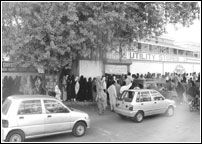 AT a time when the public anger at the unprecedented rise in prices - that too in the holy month of Ramazan - has been sweeping the country, the government was expected to provide some relief to the people. But the ministry of industries, production and special initiatives has expressed its inability to handle the price situation unless it was allowed to enter the wholesale market.
It has told the government that the Utility Stores Corporation (USC) would only prove effective if it is made an active market player.
To stabilize prices, the industries ministry officials want the USC to control 50 per cent of the total market share for 14 essential consumer items. These include ata, sugar, pulses, rice, vegetable ghee and cooking oil, washing soaps, fresh and powdered milk, red chilies and spices, tea, squashes, jam and jellies, dates, gram flour and salt.
“The corporation cannot achieve its objectives of being a price stabliser and a deterrent to profiteering, hoarding and black marketing unless it increases its market share to remove artificial imbalance created between supply and demand”, the ministry of industries and production writes to the Planning Commission.
Several years’ experience, it said, had revealed that the stockists and wholesale dealers artificially increase the prices of essential consumer items, which is a great source of concern to the government and the consumers.
“The corporation would not be able to achieve its objective if it restricts itself only to the retail activities”, the ministry wrote to the Planning Commission.
However, Prime Minister’s Advisor on Finance Dr Salman Shah, when approached by Dawn, said that at this stage the USC could not be allowed to enter into wholesale business and that its main focus had to be retail business in order to increase its outreach to the consumers.
“In the first phase, we need to strengthen the outreach of the corporation and perhaps at a later stage, the government could think of allowing it to enter into the wholesale business to compete with hoarders, black marketers and stockists”, Dr Shah said.
Also when asked about the blame game between the federal ministry of industries and production and the Punjab government over the ata crisis, Dr Shah said there was a bumper wheat crop of 23.5 million tons and both the government and the private sector made major purchases. “And they both are maintaining sufficient stocks,” he said adding that the real problem was that hoarders were not bringing their stocks in the market because of the increased wheat prices in the international market.
“But the government has decided to use its legal and administrative powers to bring down the prices of wheat and ata”, he said agreeing that the price hike particularly in Ramazan was very embarrassing for the government. He said ban on export of wheat will continue and in the meantime the government would import required quantity of the commodity to ensure price stability in the country.
He hoped that the local prices of wheat and ata would soon start coming down because of improved supplies.
The officials of the ministry of industries and production are also reported to have sought the intervention of the president and the prime minister to get early approval of the Central Development Working Party (CDWP), the Executive Committee of the National Economic Council (Ecnec) and the Planning Commission to open 5,000 new utility stores at a cost of about Rs2 billion.
The permission has been delayed although the federal cabinet had approved the decision on July 6, 2007, followed by subsequent announcement made by Minister of State for Finance Omar Ayub Khan in his budget speech to open new 5000 new stores at union council level.
On this issue, the prime minister’s advisor on finance said that 3,000 new stores out of 5,000 would be opened very soon to help consumers to get essential daily items on reasonable prices. The matter, he said, was being expedited.
Senior economist Dr A. R. Kamal, when contacted, said it was the collective failure of the ministry of industries and the Punjab government who did not restrict the smuggling of wheat which ultimately created flour shortage in the country. If the government, he said, continued to fail in curbing smuggling, wheat would continue to be smuggled to Iran, Afghanistan, Central Asia and even Russia.
Second, he said the government should firm up its policy before the arrival of any new crop so that smuggling could be stopped and hoarders and black marketers disallowed to make windfall and create problems for common man. It is some thing very upsetting that the price of flour which had been fixed by the government at Rs285 per bag is being sold in the market at Rs370 per bag,” Dr Kamal said.
Asked about the ministry of industries’ plea to allow USC to enter into wholesale business, Dr Kamal said he would not oppose the idea, provided there were certain checks and balances. He said the corporation should go into the wholesale business and those found in wrong or corrupt practices must be brought to book.
He was of the view that perhaps initially it would not be possible for the USC to go into wholesale business. But once that is done, it could opt for wholesale business and the retail business could be handed over to the private sector.