



 0
0

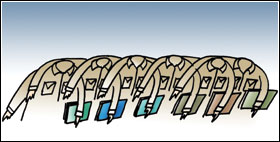 In the early days of the military takeover, the economy was in dire financial straits. The US president had declined to shake hands with the then chief executive.
Other donors were following this lead. But this did not prevent the regime from thinking big. A number of mega projects were identified for public sector investment, the Northern Bypass was one of them. The caving in of a key bridge of the Northern Bypass raises a number of issues about the project cycle, most importantly, the implementation processes and, not the least, the recently created disaster management arrangements.
Of immediate concern was rescue and relief. It was comforting to see the head of the brand new National Disaster Management Authority (NDMA) reach the site not too late. Until the October 8 earthquake, the country only knew how to manage floods disaster. The NDMA has been created since to manage all disasters, natural and man-made. Northern Bypass was its first test of a man-made disaster. It failed miserably. As the government of Sindh has not yet established the provincial disaster management authority, there was a co-ordination failure in evidence.
The NDMA head added insult to injury when he announced that he was wearing his other hat as the chair of the Prime Minister’s Inspection Commission and was there to carry out an inquiry. Now the role of this commission has long been taken over by the NAB, which occupies its building as well. An inquiry by a toothless body headed by a general, of a project awarding body headed by a general and an implementation body of the generals would itself be a disaster to be managed. And before any inquiry could start meaningfully, another body in uniform has started to remove the debris in deadly earnest. How would anyone ever find out whether the fault was with the design or the materials?
Not many would know that the implementing body in this case, NLC, is an attached department of the Planning Commission. Its role is to appraise projects, in technical as well as economic terms, and then to steer approval in the CDWP/ECNEC process. Technically there is a conflict of interest when an approving body also becomes an implementing body. Not in this case, however. While planning ministers do enjoy presiding over generals in the NLC Board, the organisation is effectively under QMG. It claims all the privileges of secrecy by insisting that it is a military organisation. So much so that when the government was desperate to show that the size of the economy is bigger than is recorded, it was discovered that any value added by NLC to the transport sector was not being accounted for in the share of transport sector in GDP. The NLC frustrated all efforts to this effect by hiding behind a veil of secrecy.
A project that has been identified, appraised and approved enters, upon allocation in PSDP, the implementation phase. This implementation is monitored quarterly by the Planning Commission in the case of large/mega projects. The member in-charge of monitoring is again a general. At any rate, the nature of this monitoring is such that it cannot detect design or material deficiencies. It monitors the utilisation of funds released and the achievement of physical targets given in the PCI. For discovery of some disasters, one has to wait until the final phase of the project cycle, i.e. evaluation which is possible only after the completion of the project. It is the lessons emerging from these evaluations which guide better project formulation in future. While the world has long moved on to post evaluation as well, the project cycle in Pakistan ends at implementation. No evaluation has been done for the past several years.
It is not entirely unreasonable for a regime to expect to see all projects started by it to complete and inaugurated during incumbency. But the pressure it exerts at various phases of the project cycle can sometime undermine the project itself. Thus too many projects were identified in the very first year of the regime, without being part of a plan. A Ten Year Perspective Plan 2001-11 was produced later, with its projects already determined. However, a rolling three-year development programming was also initiated to deal precisely with such adhocracy. This exercise was abandoned in 2002 in favour of the Medium Term Development Framework 2005-10 and a return effectively to annual planning and programming. On the other hand, the finance division is required by donors to prepare three-year medium-term budgetary framework every year. In effect, it is an exercise in simple financial projections, unrelated to the actual requirements thrown up by the project cycle.
Besides Northern Bypass, the transport sector included Gwadar Deep Water Port, Makran Coastal Highway, Gwadar-Turbat-Mand Road, Pindi Bhatian-Fasalabad Motorway, Lyari Bypass and three Roads in Northern Areas. The water sector alone included projects worth Rs186 billion, viz. Gomal Zam, Mirani Resevoir, Mangla Raising, Rainee Canal, Kachi Canal, Greater Thal Canal and RBOD II. The identification only required judgmental stories based on the experience of general officers attending the meetings. Any attempts by the civilians to analyse were interpreted as reluctance and countered by offers of help from military in implementation. Identification at the highest level made approvals by CDWP/ECNEC a fait accompli. Appraisals, especially economic, and monitoring were seen as a nuisance.
In the case of Northern Bypass, a design fault was reportedly discovered but the pressure for completion so that the project can be inaugurated, may have prevented proper remedial action. The security situation in Gomal Zam was under-estimated. Long years of drought blinded the designers of Coastal Highway and Mirani Resevoir to the rainfall data presented by some provincial irrigation experts and the insights of local communities. As a result of cyclone Yemyin and heavy rains beginning late June this year, the flood level was 271 feet above the mean sea level. The reservoir was already near-full when the onslaught came, causing a disaster which was man-made. The Coastal Highway was first damaged by rains in 2005. This warning had not yet been fully heeded and the cyclone Yemin arrived. It is back to the drawing board in both cases after tremendous avoidable damage to life and property of the poor. Katchi Canal starts at Taunsa rather than the more rational point at Guddu. The rationale of Thal Canal invariably requires special pleading.
Result-oriented timely completion of the projects is important to ensure early returns on scarce resources. But pressure to perform leads to haste. If this haste is not made slowly and in keeping with the time frame resulting from informed and careful consideration all along the project cycle, the haste can only make waste and lead to disasters which are not necessarily natural.



























