



 0
0

 Export of carpets and rugs declined from $278 million in FY05 to $267 million in FY06 and to $233 million in FY07. Exporters fear that the trend may continue for want of required support from the government to overcome problems facing the industry.
But officials of Trade Development Authority of Pakistan (TDAP) say that if the exporters adopt a realistic approach to resolve their issues, carpet exports may reach $500 million in two to three years.
Lately, the exporters have joined hands with TDAP to promote their sales. The exhibition held in Karachi last week, was their latest joint effort. The exhibition attracted over 50 buyers from America, England, Saudi Arabia, United Arab Emirates, Germany, Italy, Switzerland and other European and Middle Eastern countries.
The buyers placed purchase orders with many carpet makers. An exporter from Lahore said his firm booked export orders worth hundreds of thousands of dollars but he declined to give details. Some other exporters told Dawn that they too had done sizable business with the foreign buyers.
An official said TDAP Chairman Mr Tariq Ikram would soon meet members of the Pakistan Carpet Manufacturers Association and discuss with them how to keep a track on the foreign buyers who turned up at the exhibition. He would also discuss with the exporters how to market carpets to the chains of super stores in the US and the Europe.
The exporters say that nowadays chain stores are the biggest buyers of oriental carpets while imports by general importers are gradually declining.
They say they need the government support in winning business from global chains of super stores. “It is simply not possible for an average Pakistani exporter to reach and talk to the executives of giant global super stores. It makes a lot of difference if we talk to them in the presence of our senior government officials,” says Mr Latif Malik, former chairman, PCMA. “We have not so far received any good response from TDAP or foreign missions in this regard.”
Officials, however, say that PCMA is yet to piece together a presentation worthy enough to be made before the bosses of global chain stores. “I have spoken to the ABC chain of stores in America and I can speak to others around the world. But before reaching them we need to develop a meaningful presentation that answers specific queries,” says Mr Tariq Ikram.
Some exporters told Dawn that they are toying with the idea of organising an exhibition of Pakistani carpets at one international chain store at a time offering them substantial price cuts and getting large businesses in return.
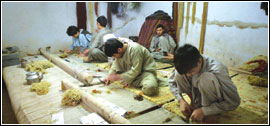
There are 400 carpet exporters across Pakistan, most of them in the Punjab. But 100 or so are active and the rest make overseas sales only occasionally. Almost the entire carpet manufacturing takes place in cottage industries with women and children weaving the pieces of art manually. Machine-made carpets are becoming common these days but they fetch little foreign exchange compared to the traditional hand-made carpets.
Three to five persons work on every carpet loom to produce an average of 10 square meter of quality carpet during a month. And there are tens of thousands of such looms scattered across the country.
There is no dearth of talented local carpet weavers but the repatriation of Afghan refugees back home has raised the cost of labour.
“A few years ago when the refugee children used to weave carpets, we were paying every weaver Rs100-Rs150 daily,” said a leading exporter who runs 3000 carpet looms. “Now we pay Rs150-Rs200 to a weaver, which makes our products costlier.” Exporters also cite higher cost of financing, ever-increasing utility charges and a general inflationary trend responsible for a 20-25 per cent increase in the cost of carpet making in last two years. “This makes us less competitive than India, China and Nepal which are fast snatching our market share.”
The result is that the share of Pakistani carpets has fallen to 1.5 per cent in the total world market from eight per cent about a decade ago.
Pakistani carpet industry is primarily plagued with the problems of supply chain, production capacity, quality control and skill development for fashion designing. Iranian carpets are more expensive yet they sell in larger quantities because the Iranian manufacturers can produce buyer-specific carpets of superb quality.
“In Iran seven universities offer education in the art of carpet weaving and nine polytechnic institutes prepare skilled workers for this industry,” says Mr Akhtar Nazir who heads World Hand-made Carpet Organization. Organized groups of carpet exporters from China, India and Pakistan and Iran may also join it shortly.
China and India, having access to cheaper labour than in Pakistan, are the top two carpet suppliers and Iran is trying to catch up with them despite the political problems it has with the West.
Pakistani carpets are generally superior to Indian and Chinese carpets but their cheap labour, low cost raw material and low utility/financing charges give them a price edge over Pakistani products..
More important, Pakistan lacks facilities to produce carpets as per requirements of foreign buyers. A single chain store in America or Europe needs hundreds of pieces of carpets made in a certain colour scheme and in a specific design. The problem is that Pakistani weavers, mostly illiterate or semi -literate women and children working at home-based looms, cannot produce tailor-made carpets of high quality.
There is a need to develop carpet clusters in the places where carpets are made. TDAP wants the exporters to develop such clusters hosting a few hundreds of looms at a certain place and then ensure quality control through periodic visits there by the experts.
Once tailor-made carpets are thus produced, exporters might bring them in carpet cities being developed in Karachi and Lahore for washing, dying and finishing. In Lahore, a piece of land was acquired for setting up a carpet city with the help of TDAP but the plan is yet to be executed.
In Karachi, TDAP and Sindh government are looking for 100 acres of land that can be given to carpet exporters on rental or lease basis for developing it as a carpet city. Exporters say once Lahore and Karachi have carpet cities they can also set up exhibition centres right at these places and foreign buyers may frequent there.
In Lahore PCMA has acquired a building to set up a world class training centre for imparting skills in carpet weaving but it is yet to hire trainers and develop a syllabus for weavers.
Unlike India, China and Iran that use modern technologies in developing graphic and computer-generated designing, most of Pakistani manufacturers still rely on traditional manual designs that are least in demand in the world.
As for marketing our carpets abroad, we need to develop a global marketing strategy with the help of the professionals. TDAP Chairman says his organisation would hire a world class consultant for this purpose within a month or two. Mr Akhtar Nazir said the world hand-made carpet organisation in collaboration with the Oriental Rug Association of USA would make a 47-minute documentary on carpet making in Pakistan, India and China.
He said that the organisation had contacted professional film makers in the US for this purpose, adding that the documentary would be shown on Discovery Channel or National Geography for promoting carpet exports.
But exporters believe that without a cut in financing cost, provision of utility to carpet weaving centres at concessional rates and without setting up an officially-sponsored training centre for carpet industry workers, carpet exports cannot be increased.
“There is no point for undertaking promotional activities if we cannot produce quality carpets at competitive rates. That is the crux of the matter,” says a carpet exporter who says he has lost millions of dollars of business to India and China.




























