0
0

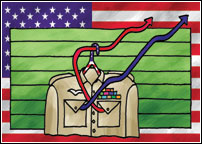 In the hype accompanying the publication of In the Line of Fire, its economic content did not get much attention. On re-reading after picking up a copy from a Sunday bookshop in Pindi Saddar where it was displayed side by side with Friends Not Masters, one found it to be arguing an economic case for political continuity.
The book is dedicated to the people whose potential is waiting to be realised by committed leadership, which can give them hope by overcoming illiteracy and poverty, the deadly combination for terror.
Several strategy sessions were held in 1999 where the author “learned” his economics. Like Mrs Thatcher who had famously responded to the opponents of her neo-liberal reform that “There is no alternative,” the author was also “quite blunt” in maintaining “that growth would take place only when macro economic stability was firmly established”.
The period of political rule starting from 1988 has been described as the “dreadful decade of democracy”. During this period, especially after the nuclear detonation, Pakistan was the most sanctioned country of the world, which affected the economy badly. Growth was low. But it was even lower, as low at two and three per cent in 2000-01 and 2001-02, as the military take-over had brought the democracy sanctions also.
The trumpeting of reform notwithstanding, the growth rates did not start to look up until the sanctions began to be removed after 9/11. “Ironically, 9/11 came to our rescue. With Pakistan joining the coalition against terrorism, we earned the sympathy of the Paris Club.” In agreeing to be with them, the refrain that past governments had done nothing turned into the fear that “our economic infrastructure, built over half a century, would have been decimated.” Economy is the only anchor available to a military regime to legitimise itself. Economic failure is not an option, even if the regime has to be economical with truth. Historically, the economy of Pakistan has always required an external stimulus for its sustenance, either in the form of an exceptional economic event or military and financial assistance. Korean war boom in the 50s and the remittance boom in the 70s fall in the former category and the largesse of Uncle Sam in the 60s, the return of Uncle Sam in the 80s and the third coming of Uncle Sam after 9/11 in the latter category.
It is no coincidence that the political decades are associated with normal economic stimuli while the military regimes invariably received a shot in the arm in the form of politically motivated security and financial assistance from the United States and its allies. The 1990s are the sole exception in that the democratic governments were fortunate neither in getting an external economic stimulus nor any other assistance due to a severe regime of sanctions in place.
What the facts show is that the transitions from military to political regimes bequeath to the latter weak economic fundamentals. Even now there is a major balance of payments crisis, with the highest ever deficits in trade as well as on current account. With the return of the fiscal deficit to levels for which politicians were maligned and for reasons of politically motivated election-related spending, the Fiscal Responsibility Law is of no consequence. All reform has been forgotten. It is amusing to see the Prime Minister announcing the setting up of a utility store in every union council. Only some time ago the number of this Bhutto relic had been drastically reduced and abolition planned on the plea that government had no business doing retailing.
Fertilizer subsidy is back with its virtues advertised in bills donning the portraits of the reformers. Legislators have access to the unlimited pork barrel. Almost every legislator holds some office. The Nazims have been handed personal cheques. It is hard to tell the “misdeeds” of political decade from the deeds of “good governance”.
In 1999, the question was: “should our strategy be to allocate maximum resources to education and health, or to development projects that would boost the economy? I decided on the latter because we needed a revived economy in order to increase funds for the social sector. This strategy worked well, and in two to three years we had reached such a healthy position that we could greatly increase funds for health and education.” The strategy worked insofar as it brought hardship to the poor, but the scene changed because of what has been said earlier, the 9/11 bonanza.
But a relaxed resource situation did not increase resources for health and education. Expenditure on health as per cent of GNP was 0.7 per cent in the last complete fiscal year of the political period, i.e. 1998-99. It remained the same until the year of 9/11 and then started to decline. In 2005-06, the expenditure on health was a paltry 0.5 per cent of GNP.
The overall expenditure on education as a per cent of GNP in 1999-2000 was 2.1 per cent. In the following years, the ratio has been under two per cent. In 2004-05, it was as low as one per cent. The expenditure level achieved by politicians remains unsurpassed. A closer look at priorities brings out a disturbing story. Literacy rate is bemoaned as “a shameful 48 per cent” in 1999, with claims to restore its priority as “the bottom of the education ladder”. Now this is an area where no number is credible. It is also an area which has suffered from unending debates on adult literacy versus literacy through formal schooling. The regime has nothing much to show here.
The most amusing claims are about primary and secondary education. All achievements are credited to the National Commission on Human Development and its chairman, and the huge efforts that provincial governments are constitutionally required to make in this field are described as “augmenting these efforts”. Interestingly, the only province mentioned is Punjab, perhaps a tacit admission that there is nothing to report from the poor, smaller provinces. So much for provincial harmony, a key point of the original seven point agenda.
What is most interesting is a complete blackout of the federal ministry of education, as if it does nothing but recruit vigilantes. The claim that the expenditure on higher education has increased substantially is correct. But it must be clear that with the relative decline in overall expenditure on education, the achievement could only be at the expense of primary, secondary and college education.
How do the poor, to whom the book is dedicated, survive then? There are many claims about madrassas, which fly in the face of facts. But the most interesting observation is that these madrassas “are very strong providers of human welfare.” This is the first port of call for the poor. After all, “Pakistan is not like the wealthy western nations that have vast resources and well-organised social security nets”. These powerless, voiceless people get from Zakat, Bait-ul-mal, wheat subsidy, EOBI, ESSI – the sum total of our social safety nets – 0.5 per cent of GDP. This is less than 0.7 per cent of GDP in the poor Nepal and 2.5 per cent in the competitor India. That social protection is non-existent became apparent in the aftermath of the earthquake of October 8, the recent floods and even the collapse of Northern Bypass.
With this state of health and education and social safety nets, where is all the growth going? In 2001, the inequality ratio was 0.275. In 2005, it rose to 0.298 and there is no reason to expect it to have declined since. In the national cake, the share of the bottom 10 per cent of population has declined from 4.4 per cent in 2001 to 4.1 per cent in 2005. The top 10 per cent has enhanced its share from 24.2 per cent to 25.6 per cent. The ratio of the richest to the poorest has risen from 5.5 per cent to 6.24 per cent.
Add to it the well-known fact that the share of the poorest is usually overstated and those of the richest understated, and the picture of a widening rich-poor gap becomes sharper than ever. This is the same period in which reduction in poverty by ten percentage points has been claimed. To justify its own generosity to the regime, the World Bank also claims reduction in poverty but by half as much. Both claims are based on data with a trust deficit. Only a judicial commission of inquiry or a sue motto notice by the Supreme Court can unearth the full facts of this ugly facet of economic governance.
The economic case for political continuity is a technocratic illusion.