0
0

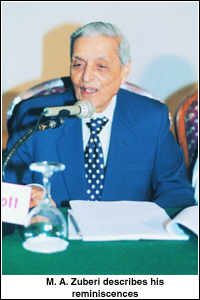 KARACHI, March 15: As a newsman who has been witness to the partition of the subcontinent and the chequered history of Pakistan, veteran journalist M. A. Zuberi recalled on Friday how he had seen rulers of all hues strut about in the corridors of power before being booted out unceremoniously.
In a talk, titled “My years in journalism — in retrospect,” organized by the Council of Pakistan Newspaper Editors (CPNE), Mr Zuberi reminisced about his first meeting with the Quaid-i-Azam at which Mr Jinnah chided him for violating an “oath of secrecy while in government service.”
Posted in an intelligence censor unit in New Delhi, where all letters etc addressed to senior civil officers of the government of India as well as Indian members of the viceroy’s executive council were checked before delivery, Mr Zuberi chanced upon a letter, marked “personal and confidential,” containing the details of an RSS plan to reduce the Muslim majority in Bengal. The letter was addressed to a Hindu officer of the home department of the government of India. Incensed, Mr Zuberi copied the letter and had it delivered to the Quaid-i-Azam.
When Mr Jinnah met Mr Zuberi for the first time, he upbraided him, saying: “You violated your oath of secrecy while in government service.” Mr Zuberi said: “Sir, I took an oath of secrecy to a foreign government and I was concerned about the security of the Muslim community in Bengal. I have already acquired release from the service to seek some other job.”
“What job are you looking for? You go and join Dawn,” the Quaid-i-Azam almost commanded him. Thus began Mr Zuberi’s journalistic career spanning over 50 years in the course of which he not only observed the Quaid-i-Azam from close quarters but also had the opportunity of seeing the seamy side of the country’s political life.
Mr Zuberi recalled how seasoned journalists used to scan the newspaper with a severe editorial eye. “Dawn’s news editor, Husain Sahib, would go through the entire dak edition and city edition, mark out the mistakes, pointing out what could be better headlines, what stories should have been displayed in a better way and what deserved front page or back page or inside page. There was not a day that the edition in charge was not rebuked for his mistakes or not correcting the mistakes of subeditors.”
Mr Zuberi also touched on a debate which has been raging for quite some time. He said: “Now it should be remembered that the Muslim League resolution of 1940 demanded ‘Muslim States in the North East and North West of the subcontinent.’ In the resolution passed in 1946 at the Muslim League legislators’ convention the letter ‘s’ was dropped and the resolution stated that ‘Muslim State in the North East and North West of the subcontinent shall be Pakistan.”
He observed that with the benefit of hindsight it could be said that had East Pakistan become independent in 1947, it would have been occupied by India.
Talking about the Quaid-i-Azam’s flinty candour, he said once the Quaid called Mr I. I. Chundrigar as the minister of commerce to explain the grant of an import permit to his family who were in business. The Quaid said: “Chundrigar, I made a mistake in making you the minister of commerce. I should have taken into account your family’s business connection. The permit issued to your family member was perfectly in keeping with the policy. But you should have sent the file to either the cabinet secretary or the prime minister instead of approving it yourself. I suggest you resign.”
Explaining how sceptre and crown tumbled down in Pakistan, Mr Zuberi said: “The game of musical chairs in Karachi started with Ambassador of Pakistan to the USA, Mohammed Ali Bogra, being appointed prime minister. Governor-General Ghulam Mohammed refused to resign when he suffered a stroke. He was soon eased out of office, and I witnessed Iskandar Mirza slapping the paralyzed old man and pushing him into a car in the portico of the now Sindh governor’s residence.”
Mr Zuberi added that afterwards he also witnessed how “Iskander Mirza was pulled out of his bedroom, dragged and finally kicked in the same portico where he had slapped Ghulam Mohammed.”
He narrated a conversation between an army officer and the Quaid-i-Azam to bring home the point that Mr Jinnah thought that the military should be governed by a civilian government. “There was a colonel in uniform who walked up to the Quaid and said ‘Sir, there are better British officers than the ones selected by you. We wish you would seek our advice in the matter.’ The Quaid-i-Azam pulled the officer by the button of his tunic and said: ‘Let me make it perfectly clear that in Pakistan you would be governed by a civilian authority and their orders would have to be carried out without murmur and demur. If you don’t do like that, don’t opt for Pakistan.”
CPNE President Mujibur Rahman Shami, Secretary-General Zahid Malik, Vice President Mahmudul Aziz, Jang Group of Newspapers editor-in-chief Mir Shakil-ur-Rahman and Nawa-i-Waqt group of Newspapers editor-in-chief Majeed Nizami attended the function.
Mr Malik announced that the next meeting would be held in Lahore on April 6 where Majeed Nizami would give a talk.