0
0

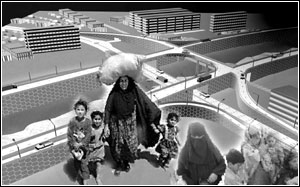 President Ayub Khan’s `Decade of Development’ stands out for its economic performance but it failed in addressing the issue of equitable distribution of resources, especially among the marginalised sections of population and in protecting the resources. Similar policies prevailed in the succeeding decades.
Now, in the name of development, people are evicted from their lands and various housing schemes have been launched on fertile agricultural lands. One should ask, what kind of development we require and at what cost?
In an anti-encroachment drive, about 30,000-35,000 people were rendered homeless as a result of demolition of nearly 5,000 homes in Korangi Town’s Gahi Faqir Goth.. The area had to be cleared for constructing a road.
Officials of the concerned town committee and the city government claimed that a notice was served on the residents and sufficient time was given to them for shifting elsewhere. However the Human Rights Commission of Pakistan said that the city government undertook the exercise in a “thoughtless manner”.
Such displacements create impoverishment and push people into a situation of transitory or permanent food insecurity because of loss of physical and non-physical assets. Not only this, when entire communities are uprooted, it disrupts seriously their way of life. Livelihoods are also affected and children are forced to quit schools. As a matter of fact, economically and politically weaker sections of society should not be made to suffer in the name of development. The first priority of the government should be to find out alternatives to displacements. If displacement is unavoidable, action should be taken in a manner that would ensure that the displaced persons would be benefited from the project.
A fair compensation should be the first demand although compensation alone is not sufficient to rehabilitate the displaced. In the past, there are examples which clearly show that government failed in providing the benefit of development project to displaced persons.
Although as per the Constitution, housing and urban planning is a provincial subject, in the case of Islamabad, the federal government was directly involved. The Capital Development Ordinance provided specific powers to CDA for land acquisition and payments of compensation. Apart from cash compensation paid according to the regulations, the affected were also given additional compensation in the form of land on concessional rate.
However, there are number of cases pending before courts regarding meagre compensations. There are also cases wherein disputes between the CDA and the affected persons led to the use of force by police for evictions. The eviction from the village, Sri Saral (D-12 area) is a case in point. Compensation were announced in 1968 and in 1969 but most people have not received any compensation as yet.
During the second tenure of Nawaz Sharif, construction work on the Lahore–Islamabad motorway was carried out in a hasty manner. Thousands of families living on the periphery of the newly constructed motorway faced extreme difficulties including division of their lands, stoppage of water supply, and blockage of the approach ways to cattle grazing grounds and graveyards. The project, in fact, disturbed the entire cultural habitat and the livelihood patterns in the area.
Taisar Town Scheme is one of the best examples of compensation by resettlement and rehabilitation of Lyari Expressway project. At that time, the city district government of Karachi, prior to eviction, announced that displaced families will be resettled or compensated according to the law.
Conversely, in present case, the city district government failed to provide any compensation or shelter by refusing their rights on the land. The question is, if, as the residents claim, the `goth’ has been around since the 70’s and 80’s, why did it take so long for the government to take action?
Various housing schemes are announced. The real estate barons come up with attractive, pollution free, green and fortified exclusive housing colonies while eliminating the lower class neighborhoods.
In the case of Punjab Employees Housing Foundation, that acquired rich fertile private lands of Bahawalpur, Multan, Faisalabad, and Gujranwala for building houses for retired/serving employees under the name of `development for public purposes” Here the notion of `public purposes’ seems to be quite debatable.
Let us look at some of the big urban centres of Punjab: Multan, Bahawalpur and Rahim Yar Khan are cotton territory. All the three cities have grown in size; many fields have given in to construction business. In Multan, even trees in some mango orchards have been felled to create space for residential areas. Lahore and Faisalabad grow wheat.
These cities have expanded manifold over the years. Indeed in some areas, the traditional rural urban distinction has been obliterated by one huge urban complex comprising houses where previously vegetable crops were grown.
The notion of development is, “constant improvement in the well-being of the entire population.” The government needs to assess all development projects to ensure that the human cost is kept to a minimum.
The immediate need is for alternate housing to compensate the uprooted people. An effort should be made to develop housing in areas that are not the most productive agriculture land. Fertile land should be protected from housing and industries at all costs.