0
0

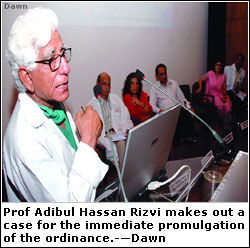 KARACHI, Aug 18: The director of the Sindh Institute of Urology and Transplantation (SIUT) and president-elect of the Transplant Society of Pakistan (TSP), Professor Adibul Hassan Rizvi, has appealed to President Gen Pervez Musharrraf to immediately promulgate the Transplantation of Human Organs and Tissues Ordinance 2007 and save Pakistan from the ignominy of being referred to as an “organ bazaar”.
Speaking at a press conference jointly organised by the Pakistan Society of Nephrology (PSN), Pakistan Association of Urological Surgeons (PAUS) and TSP at Dewan Farooq Medical Complex of SIUT on Saturday, he expressed disappointment over the government’s move of introducing the bill, already approved by the cabinet, in the National Assembly just a few hours before it prorogued after a 19-day session.
He feared that the passage of the law from the lower house of parliament would take years.
“For how long we will see the worst form of human exploitation?” he wondered and appealed to the president to promulgate the ordinance without further delay. Once the ordinance was in place, it would be easier for the National Assembly to pass it later as a law, he argued.
The struggle against organ-trafficking, he said, was decades old when the first bill was prepared by Syed Iqbal Haider in 1992. Since then, the bill has been vetted by different committees of the Senate and the National Assembly but, unfortunately, has failed to see the light of day.
“Over the years, Pakistan has earned the epithet of an ‘organ bazaar’ where people from all over the world come to buy cheap kidneys for $15,000 to $20,000. The organ trade is flourishing in Pakistan because there is no law, thanks to the government and people who are powerful enough to influence the government,” he said.
The situation, he recalled, was completely different 12 years ago when 75 per cent of the transplants concerned living and related donors. Today, 80 per cent of organ transplantation was done on a commercial basis in the country due to a lack of legislation. India was an example in this case where a law had been introduced and many doctors sent to jail for their involvement in kidney trade, he said.
Dr Farhat Moazzam, the chairperson of the Centre of Biomedical Ethics and Culture, SIUT, said that in the absence of any legislation organ-trafficking was being treated as a case of theft and doctors earlier caught for this crime had been released.
Public awareness, she said, was a long-term solution to the problem as it also had social dimensions. “Almost all the victims are illiterate people who live in abject poverty and many of them are forced to sell their kidneys to repay debts,” she said.
Answering a question regarding any loophole in the proposed ordinance, Dr Anwar Naqvi said that it was in a better shape as most of the objectionable clauses had been removed. About the future course of action, he said Dr Rizvi would meet the president in this regard. Dr Sajjad Hussain and Dr Iffat Yazdani also spoke.