



 0
0

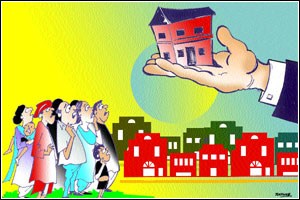 HOUSING shortage in Pakistan is worsening with every passing day. Annual addition to the backlog of 6.45 million housing units comes to about 150,000 or 410 every day.
The average household size is 6.6 persons and average occupying rate is 4 persons per room. The total availability of housing was estimated at about 20 million for a population of 140 million. Out of the total housing units two-third are in the rural areas and only one fifth are puccas (made of bricks and blocks and cement) structure, i.e. rest of the dwellings is semi-pucca or muddy.
The situation in urban areas is far worse than in rural areas. A Human Right Survey revealed that the urbanization rate in Pakistan is the highest in the world. The urban population has reached 45 million figure and is growing at the rate of 5 per cent as against the population growth of 2.7 per cent per annum. Nearly 50 per cent of the urban population is living in 2000 squatter settlements. Karachi and Lahore are the most populated cities of Pakistan and badly hit by the migration of people from rural to urban areas.
The country’s principal port city (Karachi) is said to have 539 of such ‘kutcha abadis’ that spread over more than 6,271 hectares while a similar number sits along river beds, railway lines and other scattered areas. In Karachi, a World Bank report says that 1,000 acres of highly priced land is grabbed by land-grabbers every year.
The housing need of Karachi is growing by 80,000 units per year, nearly 50 per cent of Karachiites live in slums. The estimate is that 1.6 million people of Lyari, one of its poorest areas, had an average area of 3.65 sq. meters per person - the size of a dining table-cloth - to live on. While the 24.1 million urban population of the Punjab faced a shortage of over 1.3 million housing units, Lahore is included among the 15 cities of the world with the highest number of pavement dwellers - varying between 50,000 to 70,000. In addition, Lahore is reported to have 236 ‘kutcha abadis’ with more than a million residents, and Islamabad, the youngest city and the federal capital of the country, has more than half a dozen populous settlements.
To solve the problem government made a law in 1985 but politicians and municipal officials who were reported to have transferred millions of rupees worth of state land in Qasur alone to the favourites claiming to be squatters of prized land. Without any loss of time they built 13 huge buildings on those sites.
The importance of housing and construction industry can be judged by the facts that during 2000-01 it contributed Rs. 22,374 million to GNP and provided 2.38 million jobs. It paid more tax than textile industry; 25 per cent of the construction industry’s output is contributed to the national exchequer in the form of direct and indirect taxes. Gross fixed capital formation in the construction subsector of the private sector was Rs. 10,054 million, while in ownership of dwellings was Rs. 59,772 million which was third highest. If the public sector is included the construction sector’s contribution exceeded Rs. 15 billion in the year 2000-01.
The construction sector provides jobs indirectly as well by using output of some 40 industries, which are dependent on this sector for their survival. In spite of the large contribution to the national economy the construction industry has no ministry, not even a directorate. There are no financial institutions with requisite experience of serving the construction industry. The State Bank’s Prudential Regulations regarding bonds and guarantees to the construction industry, are probably most severe in the world and are resultantly choking the construction industry. Housing finance, a major financial activity in the world, is non-existent in Pakistan. Legislation required to activate housing finance was planned several times but never implemented.
The acute shortage of housing is mainly the result of non-availability of land at affordable pricesand enough finances. There is only one institution,the House Building Finance Corporation, HBFC, which provides housing loans but its resources are so meagre that the amount does not last even for half year. During 1999-00 the HBFC disbursed Rs. 1.3 billion while in the 9 months of 2000-01 it had sanctioned loans of Rs. 779.8 million only.
To over-come the housing shortage,the government had announced a National Housing Policy on June 23, 2001. But even after a lapse of 4 months no activity is seen in the housing sector. The main reason was that financial resources were not available. Now, the State Bank of Pakistan has announced the opening of a Housing Refinance Window (HRW) with long-term funds from multilateral agencies which will be operative through housing finance companies (HFCs) registered and functional in the private and public sector.
In a circular issued to all banks,the central bank has informed them that it has decided to activate the Housing Refinance Window which will be operative through housing finance companies (HFCs).
The mark-up rate, on finance so granted by the HFC, has been fixed at 10.5 per cent per annum, whereas refinance by SBP shall be provided to the HFCs at 8 per cent per annum.
The loans will be provided to shelterless people. Every housing finance company may avail the facility initially up to a total limit of Rs. 75 million or an amount equivalent to its total paid-up capital, whichever is less. The company shall utilize the facility within two years from the date of grant, failing which the un-utilized portion shall stand lapsed.
On the other hand, the government also intends to revise its strategy for the construction and housing industry and more tax concessions may be offered to investors in this sector, as the incentives provided in the budget are not found attractive.
The other problem hampering the growth of this industry is that cement manufacturers have form ed a cartel and have raised prices from Rs. 160 to Rs. 220 per bag while the slowdown in steel units has further aggravated the situation.
The investment in the housing sector has declined sharply over the decade of 1990s from Rs. 176 billion in 1991-92, to Rs. 96 billion in 1995-96. The trend was reinforced due to the recession during 1996-97 to 2000.The public sector alsodid no better.
Now, it is to be seen whether the SBP Housing Refinance Scheme and other measures taken by the government will attract investment in the housing and construction sector or not.





























