0
0

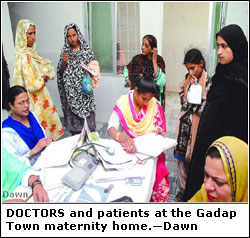 KARACHI, Aug 5: “Hepatitis has become increasingly common in villages and we have been receiving more and more cases of Hepatitis B and C,” said Medical Superintendent of a maternity home, located in Old Thana, Gadap Town, Dr Noor Qureshi, who said many cases were referred to the hospitals where better treatment facilities were available.
He said there were 11 hepatitis patients registered with the maternity home for antenatal check-ups. “Sadly, they cannot avail delivery service here because these cases need special handling which we cannot provide,” he stated when asked about the major difficulty being faced by women at the facility where a large number of maternity cases coming from the villages of Gadap Town and its outskirts, as well as Sindh interior, are handled. More than 30 women visit the facility every day and 60-65 deliveries are performed every month.
Dr Qureshi, a recent appointee, said patients with a history of hepatitis were referred to government tertiary care hospitals in the city. “In such cases, not only the life of mother and baby is at risk, but the medical staff handling them may also be exposed to the highly infectious disease,” he argued to justify the practice.
He was of the view that if there was a registered hepatitis patient, it was better to inform her about the risks involved prior to her delivery time and refer the case to a hospital having better and appropriate treatment facilities.
Dr Qureshi noted with regret that there was no government-run health care unit in Gadap Town where patients could avail diagnostic facility for hepatitis. “People, men or women, have to be referred to some other government hospital for the purpose as villagers cannot afford expensive treatment at private hospitals,” he said, suggesting that the best way to check the disease was effective prevention.
Dr Zainab Shah, in-charge of the maternity home, in reply to a question about unregistered hepatitis patients turning up for delivery in an emergency, said emergency treatment was not refused to anybody. As a routine, utmost care in handling all cases was taken and all equipment sterilised, she said, adding that extra caution was being ensured these days before admitting a case in view of the growing number of hepatitis and other high risk cases. In this context, she also pointed out that the hospital’s ambulance service had been dysfunctional for more than seven months.
Dr Shah said that high risk cases included those of acute anaemia and diabetes. “Such cases are also referred to some other government hospitals,” she said, observing that acute anaemia happened to be more common among expecting mothers. Besides poverty and lack of awareness, she noted, multiple pregnancies is a major cause.
“It’s ordinary to find women having undergone eight to 10 pregnancies but left with only three to six surviving babies,” she claimed.
According to Dr Shah, anaemia exposes women to a greater risk of having postpartum hemorrhage. We do provide women with contraceptives and motivate them to use the same but we don’t have the provision for tubal ligation. She, however, observes that over the years, women’s response to family planning services was better. As many as 30 women received treatment for tubal ligation at a camp organised by an NGO last year,
The maternity home has undergone a complete renovation a few months back. With rooms whitewashed and floors tiled, it comprises a labour room and a six-bed ward offering 24-hour service for normal delivery. However, the facility is without a doctor for night shift.
“Since it’s a far off place, doctors do not prefer being posted here. Those who are posted here get themselves transferred to some other place,” said Dr Shah.
Besides three dais, two lady health visitors and a senior staff nurse and two midwives working here under a Unicef project, “Women’s Right to Life and Health, according to Dr Qureshi, who stated that Unicef had also provided stretchers, a delivery table and equipment to the health facility.
With a new block, comprising an operation theatre and a children’s nursery, currently under construction and diagnostic facilities planned, the Rs19 million project is expected to be completed by June next year.