



 0
0

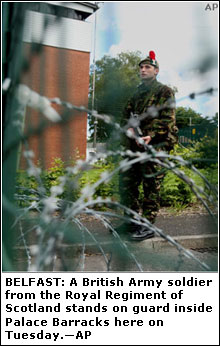 BELFAST, July 31: The British army prepared on Tuesday to end its nearly four-decade mission in Northern Ireland in low-key fashion, the latest symbolic step towards normalization in the long-troubled province.
The military landmark, from midnight (2300 GMT) on Tuesday, comes two months after self-rule was restored in Belfast following a historic power-sharing deal between former Protestant and Catholic foes.
“This is a further significant step towards the realisation of a normal, peaceful, and prosperous society in Northern Ireland,” said Irish Foreign Minister Dermot Ahern.
In London, Armed Forces Minister Bob Ainsworth has called it the “beginning of a new era.” Operation Banner, at 38 years the army's longest-ever continuous campaign, saw more than 300,000 personnel serving, over 6,000 injured and 763 killed by paramilitaries during the bleak years of terrorism and sectarian bloodshed.
All that will remain will be a 5,000-strong regular British garrison, with troops not on active service and ready for deployment around the world.
Security will be solely the police's responsibility.
The head of Police Service of Northern Ireland (PSNI), which replaced the Troubles-era Royal Ulster Constabulary — voiced confidence that his officers will be able to cope without army backup.
“We don't need them any more,” said Sir Hugh Orde. “For many months now we have not relied at all on our military colleagues for support to deliver normal policing.
“Indeed, for the past two years we have not deployed any military during the marching season — in stark contrast to 2005 when over 1,000 military colleagues were right on the frontline working very hard with my officers in some of the worst rioting we have seen in the history of Northern Ireland.” He was referring to the annual marches which during the Troubles were a regular flashpoint for violence between Catholics and Protestants.
While it will have little impact on the ground, the end of Operation Banner is another key marker point in Northern Ireland's transition from a grim backwater blighted by terrorism to a peaceful province with prospects.
In May this year, hardline Protestants and Catholic parties agreed to share power in the restored, self-rule Northern Ireland Assembly — something which would have been unthinkable during the sectarian ravages of “The Troubles.”That accord came nearly a decade after the 1998 Good Friday Agreement between Northern Ireland's political factions and the British and Irish governments, which largely ended the 30 years of violence.
The role of British troops was a highly controversial aspect of The Troubles, the decades of strife between Protestants who want to stay part of the United Kingdom and Catholics seeking union with the Republic of Ireland.
First deployed in 1969 to help restore order during sectarian riots, almost 30,000 soldiers patrolled the streets of Northern Ireland during the darkest days.
Catholics broadly welcomed the soldiers at first, but opinion soon turned amid accusations of bias and troops found themselves in the sights of the paramilitary Irish Republican Army (IRA).
In 1972, paratroopers shot 13 men dead during a civil rights march in an incident known as Bloody Sunday, one of the key events in The Troubles.
The last soldier killed was shot dead at a road block in 1997.—AFP




























