0
0

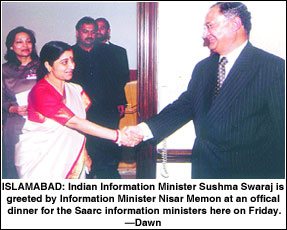 ISLAMABAD, March 8: The Saarc information ministers on Friday underlined the need for using the media as a vehicle for social change.
On the second day of a ministerial conference on information, the participants presented their country papers.
Information and Media Development Minister Nisar A. Memon presided over the session, replacing the outgoing Bangladesh Information Minister Dr Abdul Moyeen Khan.
The Pakistan paper was presented by Information Secretary Syed Anwar Mahmood.
The ministers underlined the potential of the South Asian Association for Regional Cooperation and said the media and information could play an important role in enhancing trade, promotion of tourism and sharing experiences in the field of education, health and poverty alleviation.
They said Saarc members should not disappoint people of the region in the best interest of peace, progress and harmony.
Mr Mahmood stated at the first working session of the conference that Saarc member countries should rise above geographical confines, keep peoples’ interests foremost, and build an atmosphere that would promote peace and friendship.
He hoped that the South Asian media managers would keep the interests of the people foremost in planning and implementing policies in the information sector.
“It is our belief that the main focus of the Saarc media should always remain on the challenges confronted by the people of this region. We must not disappoint our people in their pursuit of peace, progress and harmony.”
He said the media in Saarc, like in any other regional alliance or grouping elsewhere, had realized the importance of free flow and sharing of information more than any other segment of our societies.
The information secretary emphasized that the responsibility for pushing forward the objectives of the Saarc Declaration fell more on “our shoulders than on others”.
“As media managers we should be always aware of the fact that media moves faster than any other vehicle of social change.”
He welcomed the delegates to the conference and said their presence signified their personal commitment to and concern for the common objective of bringing the people of Saarc countries closer to the goals of friendship, understanding and cooperation.
At the senior officials meeting Thursday, he said, Pakistan had proposed cooperation in training of media personnel.
“We would be happy to receive six trainees every year in each of our two academies for radio and TV from member countries. Yesterday, we had also suggested institution of Saarc awards for excellence in folk music. We would be happy to host the first such awards ceremony if the member countries agree to its institution.”
He welcomed the Sri Lankan suggestion for telecast of music programmes simultaneously linking up various Saarc capitals and proposed similar live linking up of current affairs programmes.
Indian Information Minister Sushma Swaraj, in her statement said, her country was prepared to share its knowledge and experiences in Saarc’s journey towards setting up of a knowledge-based society.
“Our leaders have just concluded the 11th Saarc Summit in Kathmandu in January, 2002, and this is the first ministerial level conference after the summit.
“Our leaders have set before us a task to push ahead with the Saarc agenda for co-operation in various fields, and information and broadcasting is one of the areas that they have directed us to explore. We must, therefore, strive to achieve this goal,” she said.
She expressed concern about the “political and social impact” of programmes telecast on broadcasting services, “which are carried on signals crossing international boundaries.”
“The content of these programmes may be at variance with the ethos existing in the recipient country and this could possibly cause an erosion in the socio-cultural and moral values and traditions of our societies.”
Further, for the developing countries, the focus of the content should not remain purely commercial and market-driven entertainment, she maintained.
The powerful media, specially the electronic media, must also have sufficient software with a focus on development. Therefore, in this increasingly globalised broadcasting environment, there seems to be an imperative need for a regional understanding to observe some accepted norms of programme content for trans-national broadcasting, she added.
Heads of delegations from Bangladesh Bhutan, Nepal and Sri Lanka also made statements in the first working session and underscored the importance of enhancing regional cooperation in the vital fields of information and technology. —APP