



 0
0

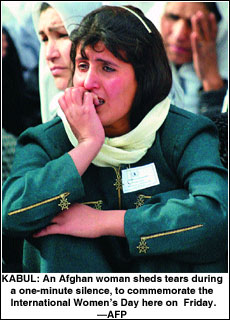 LONDON, March 8: Women worldwide were feted on Friday with flowers, tributes and good-natured jokes. But beneath the platitudes, violence and discrimination remained a daily reality for millions.
Afghan women stole the spotlight on International Women’s Day, after the collapse of the Taliban regime in December.
Marking Women’s Day for the first time in 11 years, up to 800 Afghan women gathered in Kabul to celebrate new freedoms.
“This is a great and historical day,” Interim Prime Minister Hamid Karzai said. “We are determined to work to improve the lot of women after all their suffering under the narrow-minded and oppressive rule of the Taliban.”
American First Lady Laura Bush honoured Afghan women — until recently liable to flogging or even execution for minor sexual “crimes”, forced to wear the all-enveloping burqa and deprived of education and employment — in her debut address at the United Nations to commemorate the occasion.
She and UN Secretary-General Kofi Annan said Afghanistan and other nations could not develop effectively without women playing a central role and receiving a proper education.
“Afghanistan under the Taliban gave the world a sobering example of a country where women were denied their rights and their place in society,” Bush said. “Prosperity cannot follow peace without educated women and children.”
Four months after the Taliban left Kabul, it is still rare to see women on the streets without the blue burqa, but they can now work, go to school and vote. However, a culture of violence persists in Afghanistan, Annan said in a report.
MEANINGFUL TO MERRY: Observances of Women’s Day ranged from meaningful to merry, from the banal to the bizarre around the world.
The Romanian government offered jobs to 20,000 unemployed women, the BBC World Service said. In Cyprus the Greek Cypriot Defence Ministry announced plans to recruit women volunteers to the army, currently made up largely of male conscripts.
“Call it a present,” Defence Minister Socrates Hasikos said.
In a controversial attempt to achieve boardroom sexual equality, Norway said it would force companies to guarantee that at least 40 percent of board members were women — prompting charges of tokenism from feminists.
In Colombia, men were barred from the streets for six hours, while police in Ekaterinburg, Siberia, chivalrously gave women traffic offenders flowers or perfume instead of tickets.
Global aid organisations highlighted the struggles facing women in developing countries. The International Committee of the Red Cross focused on the plight of women and girls caught up in 25 armed conflicts worldwide.
Despite specific protection guaranteed them under international humanitarian law, “women are regularly the victims of physical abuse, forced displacement, indiscriminate killing and other atrocities”, the Swiss-run relief agency said.
Women MPs from 13 Arab countries attending Women’s Day celebrations in Beirut praised Palestinian women for holding together Palestinian society and homes despite losing children and husbands in the conflict with Israel.
Amnesty International staff in Kenya said violence against women was “endemic” in the African country and elsewhere.
About 6,000 girls undergo genital mutilation each day, and up to 115 million African women have already had it, U.S.-based development agency World Vision said on Thursday.
UNICEF, the UN Children’s Fund, said a woman dies every minute while pregnant or giving birth, or 515,000 women every year — 99 percent in the developing world. It said maternal mortality was part of a broader picture of discrimination.
In Asia, protests and tributes marked Women’s Day.
Nearly 50 Bangladeshi women, their faces disfigured by acid thrown by angry lovers or family foes, and thousands of other Bangladeshis took to the streets of Dhaka to call for an end to cruelty against women.
In the Philippines, there were protests against the U.S. military presence.
In North Korea, there was nothing but praise for what authorities called the “flowers of society”.—Reuters





























