



 0
0

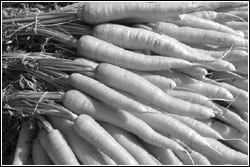 CARROT is a Latin word meaning ‘burnt’ and refers to the purple-red colour of the earlier cultivated forms. Carrot belongs to the family Umbellifereae and is an important member of root vegetables.
Probably it is a native of Asia, and at present is under cultivation in many countries. Carrot is grown here for processing and fresh market use. During 2004-2005 carrot was grown over an area of 32,604 acres in Pakistan. Its price remains fluctuating depending upon supply and demand, which range between Rs15 to Rs20 per/kg.
The vegetablet is rich in carotene, a, precursor of vitamin A and contains appreciable amounts of thiamine, riboflavin and sugar. It is a good source of vitamin B, and carbohydrates. It is used both as raw and cooked vegetable, besides in preserves, pickles etc. Tasty and delicious ‘Halwa’ is also prepared from carrots. It is considered that darker the colour of carrot the higher nutritive value it has.
Carrot is primarily grown in deep, well-drained and mineral soils. Carrots are extremely sensitive to environmental conditions such as heat, soil compaction, and particularly water stress and saturation. Farmers often intercrop carrots with rye and barley to protect young seedlings from wind damage, and rotate with lettuce and onions.
The vegetable is a biennial plant that normally requires two growing seasons with a cool rest period between them. This will complete its lifecycle from the planting of seed to the maturing of seed. However, in a single season (60 to 90 days depending on the variety and growing conditions) carrot ‘root’ is produced in suitable size for marketing. Carrot root not only anchors the plant and absorbs nutrients from the soil, but also acts as a storage depot for carbohydrates, especially starch and sugar.
Carrot is a cool season crop, best adapted to areas with long, cool growing periods free from extremes of temperature or moisture. The optimum average temperature suitable for the growth of a healthy crop is between 16 and 20 degrees Centigrade. Higher temperatures in the latter stages of plant growth may reduce yield, retard growth and produce a strong tasting coarse root.
Carrot can be grown successfully on variety of soils ranging from sandy loam to clay loam. Lighter soils help in better shape and higher yields, provided the soils have high productivity. A deep layer of loose, fertile soil with good water retentive capacity is necessary to obtain long straight roots. Well drained sandy loam to loamy land is considered best for this crop. Before the cultivation of the crop, the land should be ploughed to a depth of 3cm and clods are broken. The seeds are slow in germination and young plants are very delicate, therefore soils should not have any tendency of crust formation. Local varieties are planted in September and October, whereas imported varieties are planted in November. Late planting can be done even in December.
Carrot crop should be planted on soil containing manure of previous crop. However, chemical fertiliser phosphorus as well as nitrogenous, according to the need of the soil, must be applied. One bag of DAP and half bag of urea should be applied before sowing and half bag of urea after one month of sowing. A good nutrition programme maintains moderate to high nutrient levels in the soil with annual additions of fertiliser based on a soil test. Soil should be tested at least every two to three years. Nitrogen does not accumulate in soil over time, so it should be applied annually.
Carrots cannot tolerate drought and for better results require steady supply of moisture. The crop needs first irrigation immediately after sowing followed by light irrigation after two days. While irrigation of the field should be done in such a way that ridges are not covered with water and it should be done twice weekly. Where as, in winter irrigation should be fortnightly. Two to three inter-culturing are needed for control of weeds. The crop takes three to four months and yields about 8,000 kg/acre. Even more yield can be obtained if better management practices are followed.
Weeds reduce yield of the crop by sharing nutrients, water, and space. Weed control is especially critical early in the season for the formation of properly shaped roots, but it remains important throughout the growing season. Unlike many more robust vegetable crops, carrot requires nearly complete weed control for successful commercial production. Weeds adversely affect its quality and, late in the season, make harvesting difficult. Weeds can also act as hosts to insect pests, nematodes, and diseases of carrots. The crop is attacked by number of diseases, amongst this leaf blight, mosaic and cavity spot are most harmful.
Leaf Blights: This is a common disease of carrot, after the attack of this disease yellowish, white spots develop on leaves which later turn greyish. To prevent the crop from attack of this disease spray of Dith fungicide Dithane- M-45 is effective or seed should be treated at 126 degrees F for 10 minutes before sowing. Mosaic Aphid is vector of this disease. By controlling aphids spread of this disease can be checked.
Cavity spot: As a result of attack of this disease cavities develop in carrots. This disease occurs due to calcium deficiency. By making up deficiency of calcium in soil this disease can be avoided.
Medicinal Uses: The chief virtues of carrot lie in the strong antiseptic qualities they possess. Carrots were formerly of some medicinal repute as a laxative, poultice, etc., and the seeds have been employed as a substitute for caraways. Carrots in one form or the other is served at every meal whether in soup or as vegetables and considerable efficacy of cure is attributed to them. In country districts, raw carrot is still sometimes given to children for expelling worms, and boiled roots mashed to a pulp, are sometimes used as a cataplasm for application to ulcers and cancerous sores. Carrot sugar, obtained from its juice, may be used at table, and is good for coughs of consumptive children. Carrots are also used in winter and spring in dairy, to give colour and flavour to butter, and a dye similar to wood has been obtained from the leaves.
In conventional medicine carrots, in the form of freshly grated root or juice, are used mainly for the treatment of nutritional disorders in babies, vitamin A deficiency and threadworms. They are occasionally used as a diuretic (to promote the elimination of water). Carrot oil, the root extract in carrier oil, helps skin with insufficient sebaceous secretion. It provides sustained care for rough, dry, flaky skin and preventive protection for normal skin.
"People who eat a lot of carrots can see better and have a bronzed complexion. This healthy vegetable produces these two effects through its pro-vitamin A, which is converted to vitamin A in the human body. Pro-vitamin A is fat-soluble and therefore needs the presence of fat to be taken up by the body. Carrots should therefore always be eaten together with a little fat. Important minerals and trace elements in the carrot such as calcium, folic acid and selenium support the immune system and contribute to the development of beautiful hair and nails.





























