0
0

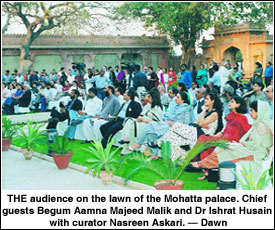 KARACHI, Feb 28: An exhibition of Sadequain’s 214 paintings got under way in the 16 rooms of the Mohatta Palace on Thursday evening.
The exhibition, which will be opened to the public next week, is titled “The Holy Sinner Sadequain 1954-1987”. It features non-calligraphic works of the Amroha-born artist.
The curator of the Mohatta Palace, Nasreen Askari, said the first seed of the exhibition had been sown by Begum Aamna Majeed Malik, affectionately known as Baji, who had loaned 14 magnificent canvasses by Sadequain.
“Each exhibition at the Mohatta palace has been special and the present one — which also pays tribute to the cultural legacy of the country — has been made possible by the remarkable generosity displayed by private organizations, public institutions and private collectors,” she said.
The co-curator of the exhibition, artist Saleema Hashmi, said that when two years ago Hameed Haroon had suggested, in passing, that a befitting tribute be paid to Sadequain at the Mohatta Palace by organizing an exhibition featuring his non-calligraphic works, she had not taken him seriously.
“Sadequain was a very prolific artist and he had many ups and downs in life. One thinks one is so familiar with his works that one doesn’t try to study him. This exhibition has enabled me to study Sadequain afresh.”
She added that some of the works on display at the exhibition had been closest to Sadequain’s heart.
Another co-curator of the exhibition, Hameed Haroon, said it was unusual for a function to have two chief guests. “But the chief guests of the exhibition — Begum Aamna Majeed Malik and State Bank of Pakistan governor Dr Ishrat Husain — are known to have a lack of ego in such matters.”
While he heaped praises on all those who had loaned Sadequain’s paintings to the exhibition — the Pakistan National Council of the Arts, State Bank of Pakistan, Karachi Press Club, Collection Services Club and 25 private collectors — he castigated those who had chosen not to loan their collections because “insurance doesn’t cover this”.
“The exhibition brought to the fore two types of spirits: one of monopoly and isolation; and the other embodied by people like Begum Aamna Majeed Malik.”
He said the exhibition — which covered the period 1954-1987 — could have started from 1952, the year Sadequain had had an exhibition in Quetta, had the owner of the paintings not backed off.
He urged the State Bank governor, Dr Ishrat Husain, to take a leaf from his predecessors’ book — who had commissioned Sadequain to paint those remarkable murals — and allow the Mohatta Palace to keep the murals, such as “The Treasure of Time” which displayed a pageant of 46 figures starting with an anonymous potter and ending with Albert Einstein, even after the end of exhibition in June for some time so that schoolchildren could come here and see the entire spectrum of human history.
Thanking all those who made the exhibition possible — Nasreen Askari, Saleema Hashmi, Farida M. Said — Mr Haroon appreciated the indefatigable efforts of the former culture secretary, Hameed Akhund.
Begum Aamna Majeed Malik spoke about Sadequain. Dr Ishrat Husain said the Mohatta Palace could keep the mural even after the exhibition.